How to structure a magic show
From repertoire to a show structure
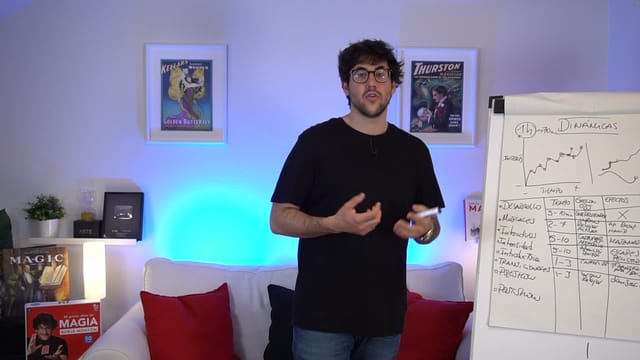
Borja Montón proposes organizing a show by focusing on the audience experience: when they become interested, surprised, participate, relax, or reactivate. To achieve this, he uses dynamics, understood as the function each trick or action fulfills within the whole.
The class focuses on planning the order, pacing, and transitions between moments. The tricks mentioned serve to analyze this organization; their methods are not taught here. The main exercise consists of crafting a sequence for an approximately one-hour show, adding up the times and reviewing how the parts fit together.
Plotting the interest curve
You will learn to represent time and interest on a graph to map out the audience's journey. A distinction is made between the climax of each routine and the finale of the show, and it examines why a powerful revelation can lose its impact if what happens beforehand fails to maintain attention.
Borja discusses examples from his own routines and a change he was preparing for the close of his show. He explains how to alternate rest and energy, and why a musical number can relax or energize depending on how it is handled. The curve is a planning tool; its effect will need to be tested through practice.
Six types of dynamics
- Development: routines with a presentation, progression, and resolution. We study how to maintain interest throughout the performance and give meaning to the events separating the beginning from the final effect.
- Musical: numbers where action and music drive the experience. We analyze their potential to shift the pace, relax the audience, or elevate the energy.
- Interactive: actions involving all spectators or a large part of the audience. We discuss the clarity of the instructions, the time needed to follow them, and the risk of overly complicated participation failing to work. The collective choice of a volunteer can also serve this function.
- Intensity: moments that build tension and build momentum toward the finale. Escape art examples are analyzed as presentation resources; their execution is not taught, nor is it required to include a danger act.
- Introductory: brief effects that introduce an object or theme and set up a longer routine. The goal is to capture attention and provide a clear entry point into what follows.
- Transitional: changes in lighting, sound, staging, or other sensory elements that link moments together. They can connect two numbers or different parts of the same routine without becoming another full trick.
These categories can be combined. The same number can feature music, introduce a theme, and be part of a larger development; it is not about classifying it in only one way.
Duration, objective, and quantity
During the explanation, a table is built to note down the duration, emotion or objective, types of effect, and the approximate quantity of each dynamic. As a guideline, Borja suggests development and interactive routines of five to ten minutes, musical ones of two to seven, and introductions or transitions of one to three.
He also suggests moderate quantities to avoid repetition and discusses how to adjust what follows an intense moment. These are recommendations from his experience for a roughly one-hour show, not mandatory limits or a formula guaranteeing results.
Before and after the show
The work includes pre-show and post-show dynamics: what happens while the audience is waiting and what can extend the experience upon leaving. Waiting music, messages, participation, small puzzles, and actions related to the show are discussed.
Cases from other artists are narrated examples to help think about these possibilities. They do not explain how to reproduce their effects, nor are they presented as included material.
Your planning exercise
Prepare a table, identify the function of the tricks you want to use, and test an order. Add up the durations, draw your desired interest curve, and review the transitions and the finale. Then rehearse the sequence and modify any parts that drag out or lose interest.
To follow the class, a pen and paper or a document to organize your ideas is all you need. To apply it, it is best to start with a few tricks you already know and have an idea of the type of show you want to present. You do not need staging or technical equipment to do this exercise, and this is not a class on lighting programming, musical selection, or performing the mentioned effects.