Ball Manipulation with Shells: Multiplications and Routine
Multiplications Within a Manipulation Routine
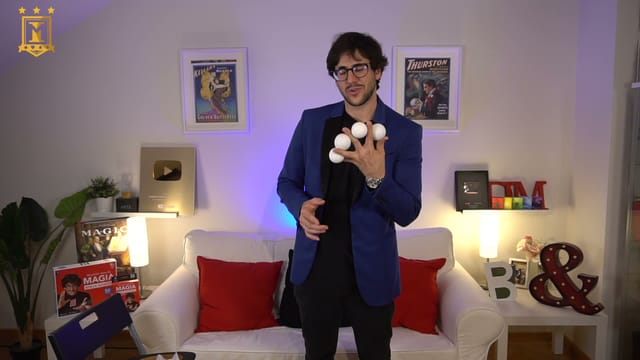
Borja Montón breaks down the handling of shells to integrate ball productions, vanishes, and multiplications into a stage act. The lesson combines basic material technique, a continuous multiplication exercise, a practice routine with a silk and hat, and the analysis of a final sequence used in his own act.
Material, Orientation, and Angle Control
The explanation begins by comparing different shells: thickness, durability, feel, and fit with the balls. Borja uses two-inch props and discusses how a smaller size can facilitate certain moves. The size must allow you to hold and separate the elements with control; no single size is presented as suitable for all hands.
You will learn to check the material's orientation toward the audience, maintain that orientation during transfers, and avoid positions that expose what should remain hidden. The connection between the props and spectators seated to the sides requires attention. It is recommended to practice with a mirror or camera from the spectator's perspective, rather than just correcting what the performer sees.
Basic Handling and Continuous Multiplication
The lesson covers the production and vanishing of a ball with a shell, their hand-to-hand links, and the coordination needed to make the moves flow seamlessly. Common issues are reviewed: squeezing too hard, tilting the hand to compensate for an insecure grip, losing orientation, or separating the pieces before the move is ready.
The continuous multiplication exercise is used to repeat productions and transfers without stopping to reset each position. Borja shows how to practice this with both hands and how to recognize grip errors that cause drops. The goal is to maintain a clear action and a stable position before increasing speed or adding more elements.
A Practice Routine with a Silk and Hat
The class explains a practice sequence combining the silk, the hat, ball productions, and multiplication. Preparation, transitions, prop retrieval, and the moments when each object comes into play are reviewed. The silk has a functional role in the presentation; it is not just a prop held while the sleight happens.
The explanation links these resources with transfers and the Willy Monroe palm. It also utilizes a silk production that is assumed to be known. It is best to master those basics to focus on the additions in this class: not all the palms and productions used are taught from scratch again.
Two Approaches to the Final Production
An important part is dedicated to the simultaneous production of two to four balls in one hand. The opening, finger coordination, stability, and the difficulties that arise with large balls are analyzed. It is a demanding phase that requires specific practice; it is not presented as an immediate result.
Next, Borja explains a closing sequence using a different handling: a production of one to three balls, the addition of a fourth, and the transitions that allow you to maintain control between phases. Coverage, gaze direction, and gesture continuity are studied. These are two solutions with different demands, allowing you to choose and practice the one that best fits your act.
Finally, color change possibilities are discussed, and a small spinning toss is explained as a flourish. References to producing eight balls or finishing with a special ball, a silk, or a lamp broaden the material's possibilities, but do not equate to teaching full routines with those finales or building those props.
What You Need and How to Approach Practice
For the practice routine, you need two manipulation balls with two matching shells, a silk, and a hat with an inner band. Also check the placement of your pockets and have a mirror or camera to verify angles and continuity. You do not need the special props mentioned as optional finales to practice the core work.
It is recommended to comfortably handle a single ball, know basic transfers and the Willy Monroe palm, and have experience with silk productions. Practice the one-handed handling first, then the transfers, and finally the routine's links. Multiple productions require more practice time than the initial shell productions.