Warm-up, Attention, and Stage Listening
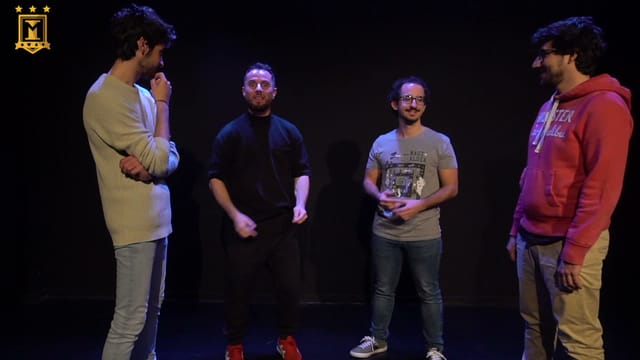
Performing involves attending to what happens while executing work you have already prepared. Gerard Clúa proposes an acting session based on play: warming up the body, listening, responding to a cue, and continuing even if a mistake occurs. The dynamics are carried out with participants and discussed during practice to observe successes, doubts, and blocks alike.
Preparing the body to perform
The warm-up covers ankles, knees, hips, waist, chest, shoulders, elbows, wrists, and neck. It works on awareness of the moving area, separation between body parts, and the search for more fluid movement. An equilibrium exercise also appears to observe how stability changes when modifying the visual reference.
Gerard relates this bodily attention to situations where the magician must coordinate hands, patter, and gaze. Corrections show how a seemingly simple movement can demand concentration and repetition. The instruction to respect one's own body is explicit: if an exercise causes pain, it should not be performed.
Claps, gaze, and response
The first game consists of passing a clap within a circle, indicating its direction with gesture and gaze. Afterward, direction changes are permitted, and a cue is added to skip a participant. The difficulty increases without changing the objective: recognizing whose turn it is to respond and sustaining a shared rhythm.
Interruptions serve to observe what happens when someone over-prepares their response, stops paying attention, or reacts to a movement intended for someone else. It is proposed to work on the impulse to respond to what arrives without stopping out of fear of making a mistake.
Peripheral vision is also introduced: maintaining a focus without losing information about the space and those around. Applications such as locating an object or perceiving a partner without having to direct one's entire gaze toward them are discussed.
Sound cues and movement
A second game combines voice, gestures, and direction changes. It starts by passing a cue and progressively incorporates the bounce, skipping a partner, and changing direction with a jump. Each rule is demonstrated before integrating it into the exchange.
The exercise brings together visual and auditory attention, coordination, and vocal preparation. Syllables are part of the game's rules. Errors such as mixing two cues, anticipating, or changing intent mid-movement are observed; Gerard uses them to comment on the clarity of the action and the need to remain available to the group.
The purpose is not always to react at maximum speed. A response can take its time and still remain clear if the performer maintains attention and does not lose the relationship with others.
Differentiating rhythm and tempo
The class distinguishes the rhythm of a scene—with faster or slower moments—from the performer's own tempo and presentation style. References to Juan Tamariz and René Lavand illustrate different styles; these are neither performances nor complete analyses of their acts.
It is proposed to know one's own tempo to use it rather than imitating a speed that feels alien. A calm presentation can contain a great deal of activity, and rapid energy requires control for the action to remain understandable. Rehearsed work and listening make it possible to respond to unexpected audience events without abandoning the structure of the performance.
Attention and memory with a count to seven
The final dynamic passes a count among the participants. The gesture indicates whose turn it is to continue, and gradually, certain numbers acquire specific movements or a distinct vocal cue. Rules accumulate to work on memory, precision, and attention simultaneously.
Repetitions show how the group incorporates the instructions and how they make mistakes again when difficulty is added. Corrections focus on marking the movement clearly, recognizing direction, and continuing to play. It is also discussed how a spontaneous reaction to a mistake can generate communication and complicity with the audience.
What you need to practice
Reserve a clear space to move and use only the ranges of motion that feel comfortable to you. You do not need props or magic materials. The warm-up can be followed individually; the games are shown with three or four participants and work as shared labor. From home, it is suggested to follow the directions or assume the turn of one of the people in the video, although that adaptation does not reproduce all group interaction.
No prior acting experience is necessary. To bring these ideas into magic, think of a routine you already know and observe how you coordinate body, text, gaze, and response to the spectator. The lesson provides preparation and listening exercises, not the explanation of a specific trick.