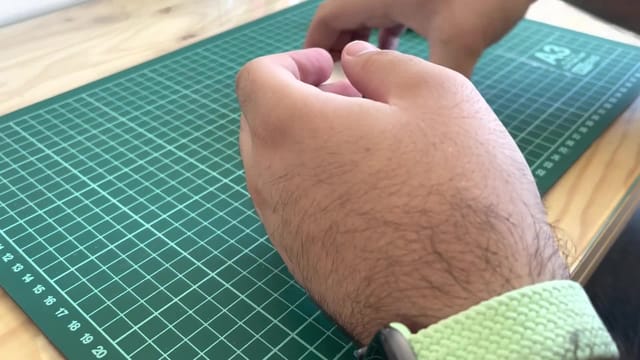
Business Card Peek: Construction and Three Handlings
What the spectator writes remains between the cards
This lesson by Julio Montoro develops a peek device built with business cards. The spectator writes a city, a drawing, or other information on a card; this is inserted among the others, and the handling allows you to obtain the information to use it in a mentalism presentation.
The demonstration is performed to the camera: Montoro writes and acts out the actions to show what the sequence would look like. He then explains the construction and three ways to obtain the peek. This distinction allows you to study the handling without confusing the solo demonstration with a performance recorded before a real spectator.
Preparing the small packet
The starting material is ordinary business cards. They can be your own or from a business; the important thing is to have the ones necessary to build the set and additional cards for the presentation. A utility knife, a ruler for the adjustment that requires precision, and a marker to write are also used.
Montoro explains the preparation of a group of cards, the fabrication of a slightly shorter card, and the order of the pieces within the packet. He distinguishes the cuts that allow a certain tolerance from the small adjustment where he uses the ruler. This way you can understand how to locate the working position and preserve the outer appearance of a normal set.
The gimmick is prepared before the performance. The lesson teaches how to make and handle it with everyday materials, without presenting the procedure as something that can be done immediately with an unprepared packet.
Receiving and placing the written card
The explanation continues from a perspective that allows you to follow the performer's actions. You will learn to hand out the card so the spectator writes in the center, show the packet while they do so, and retrieve and insert the card into the necessary position.
Montoro discusses the turn with which the other side of the set is shown and the function that this display fulfills within the sequence. He then explains how to locate the short card and use it as a reference. The preparation and reception of the card are studied together so that the peek has a clear context.
Three ways to obtain the information
The first handling uses the turn of the packet to obtain the information and return the set to its position. The explanation goes over the finger grip, the back-and-forth movement, and the moment when what is written is seen. Montoro shows the action several times so you can study its direction and coverage.
The second option links the peek with the withdrawal of a card on which you are going to write your impression. That action provides a reason to take another card and continue with a duplication of the information. Orientation toward the performer and the possibility of putting the packet away while the revelation unfolds are worked on.
The third variant uses a display with two cards perceived as one and allows you to finish showing the card intended for duplication. Montoro explains the take, the display, and the subsequent separation. It is an alternative handling within the same device, not another prop that you have to buy.
From information to presentation
The cities used in the explanation serve as examples of the data obtained. The principle is also presented for a drawing or something else that the spectator writes. You can use the peek for a verbal mental reading or to reproduce the information on another card, following the links taught.
The tutorial concentrates on building the device, receiving the card, and obtaining the information with cover. The presentation of the revelation is illustrated with brief examples; it is not offered as a complete course in mentalism performance.
It is a lesson for anyone who wants to prepare a small resource with business cards and work on the naturalness of the handling. It is advisable to rehearse the placement of the written card, the turns, the orientation of the packet, and the withdrawal of the cards before combining them into your own presentation.