Senses: A card vanishes and appears inside the card case
A card you see and a card you hear
Senses features a card placed on top of the deck and a card case that, when shaken, appears to contain nothing because it makes no sound. The card vanishes visually; then a sound is heard inside the box, and the selection is revealed inside.
The tutorial begins with a clip of the version recorded for social media and then goes into the construction and adaptation for performing live for people. The current lesson combines the vanish gimmick with a card case handling to control the sound. That difference allows you to study the visual effect and the complete path a live routine requires.
Materials and construction
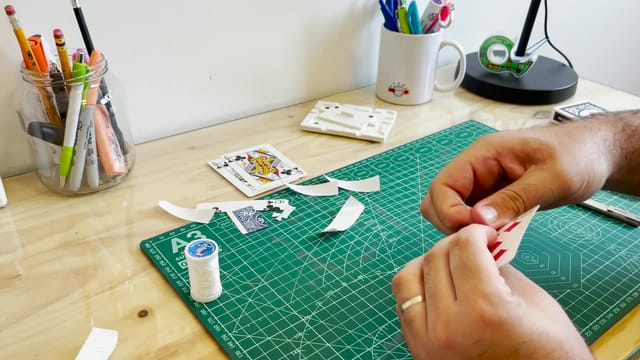
For the set, you need three identical cards, preferably face cards, two additional cards, a deck, and its card case. The fabrication uses double-sided tape, elastic thread, a needle, a utility knife, and a ruler; a pair of scissors makes trimming easier. The specialized cutting tool shown in the explanation is optional: Montoro also explains how to work with a utility knife.
One of the identical cards and the two extra cards are used for the gimmick; the other two identical cards are incorporated into the routine's handling. Montoro covers preparing the crease, the gluing orientation, adjusting the pieces, and trimming the excess. Next, he shows the holes, the routing of the elastic thread, and the knotting.
The construction is tested by opening and closing the prop. The tutorial discusses the lines that might become visible and the angle that favors the illusion, as well as the use of movement and the subsequent turning over of the deck. It is a gimmick that requires preparing and practicing its exhibition conditions.
Making the card case sound when desired
The routine begins with a card already placed inside the box. The impression of emptiness is built through sound, not by showing the interior empty. Montoro explains how to manage the grip and the flap to alternate between silence and the noise of the card.
Ways to adjust this action depending on the card case are discussed, and how a brand-new box influences it is tested. It is advisable to test the response of the specific material you are going to use: that preparation is part of the effect, alongside the visual vanish.
Table handling with lapping
The version preferred by Montoro takes place at a table and utilizes lapping. He explains the initial setup, the directed selection of one of the identical cards, and controlling the necessary position when shuffling.
Next, you study how to retrieve the card, open the gimmick with cover, and connect the display with drawing attention to the card case. The handling includes a lapping dump and coordination between holding the flap open, showing the vanish, and allowing the box to make sound again.
The climax connects both senses: the absence of the card on top of the deck is shown, and the card case is opened to find it inside. The tutorial allows you to follow this chain of actions right up to the revelation.
Alternative without lapping
The second version keeps the preparation and changes the connection used to withdraw the card. Montoro develops it for a situation without lapping, including a standing performance. Second position placement, hand cover, and spectator attention are worked on as parts of the same movement.
Emphasis is placed on directing the gaze and conversing during that action. The tutorial itself presents this as a more demanding alternative and points out that the table handling is his preferred option. You will learn what changes between the two versions so you can choose the one that fits your performance conditions.
What to practice before performing it
The class shows a force and mentions the classic force as an alternative; the choice must match the prepared cards. The face cards and values used during the explanation serve as examples of this need for matching.
This is a lesson for anyone wanting to craft a visual vanish and turn it into a travel-to-the-box routine. It requires preparing the duplicates and the gimmick, adjusting the sound, and practicing the covers, card control, and timing of the finale. The initial demonstration teaches the idea; the two explained handlings provide the development to perform it for an audience.