Signed Card to Tic Tac Box
From a Visible Prediction to a Signed Card
A Tic Tac box displays a folded card from the very beginning. After the spectator signs another card and it gets lost in the deck, the magician opens the box and pulls out the signed selection. Julio Montoro teaches how to build the prop and how to load the real card while picking up the container.
The presentation uses the concept of a prediction, but the routine developed is the arrival of a signed card inside the box. The content covers the assembly, the preparation of the selection, the load, and the extraction method.
Building the Container and the Apparent Card
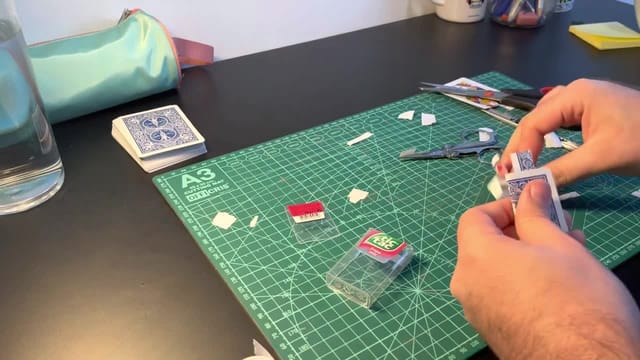
You will need an empty Tic Tac box, cards you can cut and fold, scissors, a utility knife, double-sided tape, and clear tape. Julio opens and modifies the container, calculates the size of the folded card, and prepares the part that makes that card visible inside the box.
The explanation covers cutting the back and making adjustments so the load slips in effortlessly. He also adds a piece of a card and shows how to attach the assembly to the moving part when opening. Centering, closing, and an optional reinforcement are covered to ensure the preparation stays firmly in place.
The construction requires cutting plastic. The instructor emphasizes caution with the utility knife, switches to scissors for a tricky part, and advises minors to ask an adult for help. This is not just a normal box that needs emptying: modifying the container is an essential part of the lesson.
What the Participant Can See and Hold
The prepared back is never shown. The box is presented with a specific orientation; Julio notes that the participant can hold it closed and face-up within that presentation. That does not mean they can turn it around and freely inspect it from all sides.
The explanation ties this orientation to the load and the subsequent opening. It is worth practicing how it is left on the table, how it is picked up, and which side must keep facing the audience so the dummy card serves its purpose.
Control and the Mercury Fold
The selection is signed and controlled to the bottom of the deck. Julio allows you to use a control you already master and shows examples, without turning the tutorial into a comprehensive course on controls. Next, he explains the Mercury Fold: the concealed folding of the card to prep it for the load.
He also suggests making that fold easier by adding preparation marks to a specific card. That variation adds a force to reach the prepped card; it is not a mandatory condition for the initial approach featuring a selection and control. The tutorial distinguishes direct folding from this setup aid.
Load, Extraction, and Ending Condition
With the folded selection retained in your hand, Julio teaches how to introduce it while picking up the box and passing the setup from one hand to the other. Opening it moves the fake card out of view and allows the real selection to be shown.
He explains how to insert a finger to pull out the card, set aside the container, and reveal the signature. If you want to bring the box out again or hand it out for examination, he mentions switching it for a regular one; that condition doesn't magically make the gimmick container examinable as-is. The lesson covers the load and extraction, not a fake free inspection of the modified box.
Materials, Practice, and Other Possibilities
Aside from the prop, you will need the deck, a marker for the signature, and practice with the control, the hidden fold, the retention, and the load. The construction is explained from scratch; coordinating it with your patter and the box's orientation takes rehearsal.
At the end, other ideas are discussed, such as a banknote or a written paper prediction. The named city concept uses an assistant who writes down the info: it is an additional idea, not an autonomous prediction of unknown information. The routine detailed throughout remains the signed card in the box.