The deck vanishes and only the signed card remains
The deck vanishes, the selection remains
A spectator chooses a card and can sign it. After seemingly losing it in the middle of the deck, Julio Montoro proposes finding it in a different way: first half the deck appears to vanish, and then the other half, until only the chosen card is left.
The lesson details the construction of a prop that represents the thickness of the deck and the handling that leads to that sequence. The object that vanishes during the performance is the deck; the selection remains as the finale and can be shown after removing the gimmick.
Preparing the prop
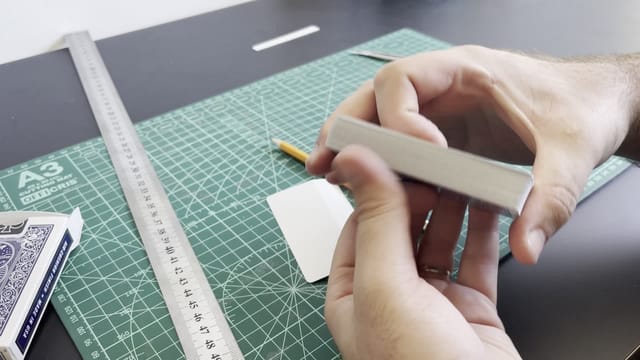
You need a card with one blank face; the back can be a standard design, blank, or show a normal face. A ruler, a utility knife, and a well-sharpened pencil are used to make it. The routine also requires a deck and a marker if performed with a signed card.
Montoro demonstrates how to take the thickness of the deck as a reference and prepare the cuts and folds of the piece. The explanation distinguishes between cutting out the shape and scoring the surface to allow the cardboard to bend. He then uses the pencil to suggest the edges of a packet of cards.
The fit is checked by placing a card on top and studying the appearance of the assembly. The construction uses few materials, but it requires a shape and lines consistent with the deck being represented.
From the selection to the prepared assembly
The explanation continues with the initial placement of the gimmick, the selection, and a double lift to link the presentation of the card with its apparent return to the center. Montoro reviews the removal of an indifferent card and the position in which the assembly is left to begin the visual phase.
The main handling involves palming the deck away and pocketing it, taking advantage of patter and movement. This part requires cover and coordination; it is not presented as an unprepared vanish without technique.
An alternative is also proposed: pocketing the deck during the routine and retrieving only the assembly to be used for the effect. You can study both paths and choose the one that fits your performing style and pocket access.
Two visual phases and cleanup
With the assembly in place, Montoro shows the hand positions and the covered angles. The first fold is executed to reduce the apparent size of the deck by half, and the second fold leaves only the top card remaining.
Next, he explains how to remove the auxiliary prop and show the chosen card. The card can be examined at the end once the cleanup is done; the preparation remains part of the previous sequence.
The explanation repeats the path from selection to finale so you can study the transitions. Rehearsal work is needed both for removing the deck and for the clarity of the two vanishes and the kicker.
Scope and practice
Montoro mentions Level One as a reference for comparison, but this lesson develops a custom setup using the described blank-faced card. You do not need to purchase that product to follow the construction.
This is a lesson for anyone who wants to craft a deck vanish prop and is willing to practice the handling. It is best to practice the double lift, cover, palm or pocket alternative, folds, and cleanup. The tutorial walks through these paths and notes that the main handling requires attention, leaving room to adapt it to the performer's style.