The Printer: From a sticky note to a real banknote
Turning a note into real money
Julio Montoro uses a playing card as a support to transform a sticky note into a folded banknote. In the developed application, he writes “20 euros” on the paper and visually changes it into a real note of that value, which he can then remove and hand out. The lesson teaches construction and performance with the prepared card; no finished accessory purchase is required.
Building the card
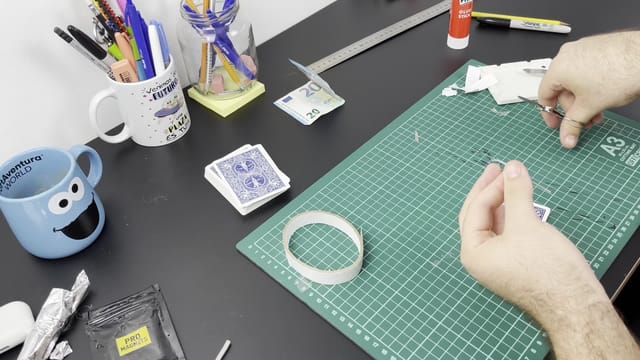
The explanation starts with a flap and covers its construction: preparing the fold in the card's layers, joining another card, positioning the closure magnets and installing elastic thread. Julio changes the magnet count during construction and shows how to secure the parts and trim excess. The aim is to understand arrangement and function, rather than follow an initial materials count that remains fixed throughout the recording.
He also teaches threading the corners, adjusting attachment and avoiding trapping the thread while gluing. He then adds finishing pieces from the halves of another card to improve what can be shown. Adhesive, drying and alignment details affecting movement are explained alongside the mechanism.
When showing how to keep the flap closed, Montoro mentions an idea from Juan Capilla. That credit concerns the particular idea indicated at that point; Montoro teaches this lesson's construction and handling.
Preparing the sticky-note-to-banknote change
The tutorial continues with positioning the paper and money: sticky-note size relative to the assembly, use of its own adhesive and attachment of the folded banknote at the other position. This paper-to-money change is the developed application. General possibilities of changing objects mentioned at the start do not replace a specific explanation for every imaginable object.
Learn how to hold the assembly before the change, where to put the finger and how to pass it between hands without the finger obstructing the mechanism. Julio repeats the transformation and explains removing the banknote without drawing attention to its attachment.
What can be shown at the end
The banknote can be handed to the spectator after removal. The card remains a prepared accessory: its faces are displayed with the indicated cover, keeping the finger-covered area hidden. It is not an ordinary card for unrestricted examination, nor a change allowing the back to be shown beforehand.
Materials, preparation and practice
You need several same-size poker cards for the mechanism and finishing, small magnets, elastic thread, a needle, ordinary and double-sided tape, glue, cutting tools, a sticky note and a banknote. Montoro recommends blue backs in the example. Wonder Cutter is optional cutting assistance; he clarifies that a ruler and craft knife can be used instead, so buying it is not required.
Flap construction and handling are taught here. You must prepare the card, adjust thread, closures and finishing, and rehearse cover and the hand transfer. It suits those wanting to build a visual transformation with a card and a paper object while understanding its actual handling conditions, both on camera and in person.