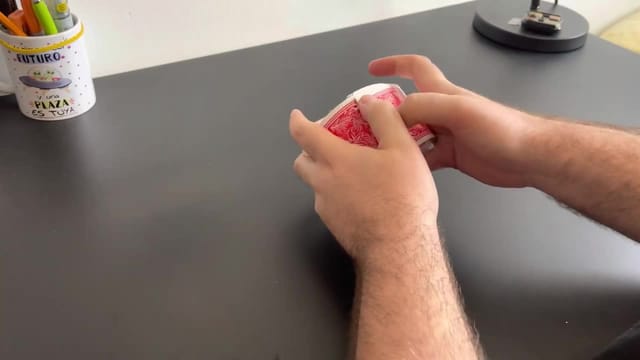
Jules Control: The card ends up on the bottom during a table cut
A control built into the spectator's cut
The spectator cuts a shuffled deck on the table, remembers the card shown to them, and watches you replace the packet. By the end of that action, their selection is controlled to the bottom of the deck. Julio Montoro presents the Jules Control and explains the subtle sleight integrated into that sequence.
The cleanliness lies in the appearance of showing and replacing the cards, not in the magician entirely avoiding touching them. The explanation reveals what the hand lifting the packet actually does and how that exact path is used to bring the selection to the bottom.
Grip, movement, and crimp
First, the move is isolated using roughly half the deck. Julio teaches the finger and thumb grip as well as the displacement the card requires, using a slight tilt rather than an exaggerated gesture.
He then adds an important detail: a slight crimping of the cards before asking for the cut. This shape makes it easier for the selection to enter when returning the packet. The tutorial connects the preparation, the way the cards are gathered, and the orientation the hand must maintain from the beginning.
The explanation covers the handling from the audience's viewpoint and shows what happens from behind. It is a study perspective designed to help you understand the move; you will need to practice the position and cover under your own performance conditions.
Showing, remembering, and returning
The participant cuts wherever they like, and the card is shown to them. Julio stresses gathering the packet in the exact configuration that will allow you to execute the sleight upon return, rather than trying to correct the grip afterward.
The complete sequence is repeated: the cut, remembering the selection, returning the packet, and the card controlled to the bottom. A line is also included to remind the participant not to forget their card, along with the concept of covering a small move with a larger one.
This allows you to practice the technical action separately and see its continuity within a casual gesture. The taught result is the bottom control, ready to lead into another application.
Materials and further possibilities
You will need an ordinary deck and a table surface. No props are constructed, and no commercial magic product is required. The handling allows for a prior shuffle and a spectator cut, but it requires practicing the crimp, the gather, and the travel of the packet.
Julio demonstrates brief possibilities once the card is controlled, such as palming it and loading it into a wallet or a card case. These are suggested outs to make the most of the control; the lesson focuses strictly on technique and does not develop a full card-to-wallet routine or a palming course.
In the recording, the name is credited to his friend Iván, Magic Ruiz. The instruction is led by Julio Montoro. It is a proposal for anyone wanting to add a table control to their card magic and work on the naturalness of a brief action, paying close attention to the real handling that sustains that illusion.