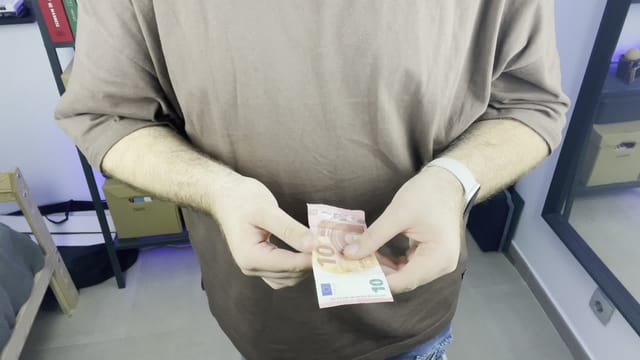
Zigzag bill with ordinary money
Visually separating and restoring a banknote
With one banknote providing cover, part of another seems to move sideways and then return to its place. Julio Montoro demonstrates this zigzag, introduces an optional signature and explains how to finish by handing out the two notes the audience has seen for examination.
The explanation uses ordinary banknotes and their folds and grips. There is no need to cut or glue money or buy a gimmicked note. Although the presentation shows two notes, preparation requires three: two of the same value and a third of a different value.
The folds behind the illusion
The tutorial separately shows how to fold each matching note and position them to appear as one. Julio uses ten-euro notes and design features as folding references. He also mentions other value combinations, retaining two matching notes and one different; he supplies neither measurements nor specific verification for every currency.
He then explains the grip and placement of the covering note. Learn to guide the apparent displacement, keep the assembly in position and return it to its initial appearance. He repeats the sequence to connect the preparation folds to what the spectator sees during the movement.
Signature and examinable ending
The signature option has conditions. Julio distinguishes a signature the magician can prepare on one part from one the spectator can place on the part they will receive. This does not mean signing anywhere: placement must suit the assembly and the note that reaches the audience.
Cleanup is taught as part of the tutorial. You will see how to fold and extract the note to be handed out, keep the additional note hidden and use its folded position to retain it in the hand. The two visible notes can then be examined. That ending requires cleanup; the prepared assembly is not freely examinable before or during the zigzag.
Materials, preparation and practice
You need two banknotes of the same value and one of a different value. The example uses two tens and a twenty in euros; Julio mentions other combinations as alternatives. Add something to write with if using a signature, and respect the explained placement.
This is manual preparation with ordinary banknotes, without adhesives, cuts or a special accessory. Julio presents it as something you can prepare at any time; you still need to arrange the folds and have the extra note before performing. The lesson teaches that preparation, movement and cleanup. Practise alignment, finger pressure and final concealment so the audience sees an impossible separation and a clean return rather than the parts of the assembly.