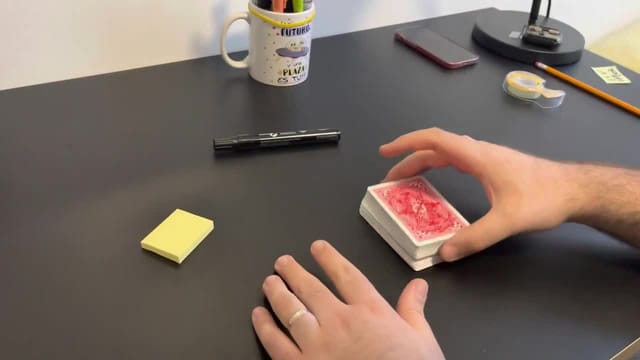
Sticky-note prediction of a named court card
A prediction among the cards
A prediction is apparently written on a sticky note, attached to a card and placed in the deck. The participant eliminates options and names a court card. That card is removed to be saved, and the note is then found predicting the same choice.
Julio Montoro demonstrates and explains a deck prepared specifically for this routine. Although the presentation may sound as if any card could be named, the taught procedure directs the choice to one of the twelve jacks, queens and kings. That condition is part of the method.
Materials and deck preparation
You need a deck retaining all court cards and four aces, a pad of sticky notes, a marker or pencil and double-sided tape. The preparation uses ordinary cards; a special commercial deck is not required.
Twelve predictions are written and distributed in an order that allows them to be found. The aces act as suit guides to locate the corresponding jack, queen or king. Julio explains the relationship between the guides and the notes.
Placement of each note matters: it goes toward the specified edge so it does not show when the deck is spread from the intended direction. The tutorial covers the prediction cards, covering cards and the area containing the court cards to be removed. The card that retains the initial note uses double-sided tape; an anti-slip treatment is mentioned as an alternative, not an extra compulsory product.
Directing the choice to court cards
The verbal procedure distinguishes number cards from court cards and announces that cards will be eliminated while one will be saved. Both possible responses are covered, preserving the idea of saving a court card.
Julio stresses the wording and attributes this approach to Joshua Jay, mentioning Inferno as a reference. Only the part needed to reach the court cards is used; the whole Inferno routine is not taught and buying it is not required. Freedom within the court-card group must be distinguished from an unrestricted choice of any card in the deck.
Placing the note and locating the answer
The initial note appears to contain the prediction and is briefly shown without being read. Julio explains placing it among the cards and retaining it with the adhesive preparation, clearing the way for the eventual answer.
Once the court card is named, its guide is found and a cull moves the card carrying the corresponding note. The named court card is then located and removed from the intended area. Examples with different choices and replacing the elements are shown. Spreading from the wrong side can expose the preparation; that direction must remain protected at the final display.
Final display and practice
The spectator can inspect the removed court card and certain cards, but part of the deck remains prepared and is not offered for unrestricted examination. Removing those prepared cards while gathering and leaving the rest is discussed as an additional handling, not an automatic cleanup.
Practise the downward cull, the guide system, the verbal choice and coverage of the notes. The lesson combines demonstration, building a deck for one effect, verbal choice, location and revelation. It suits someone interested in multiple sticky-note predictions who accepts carrying a dedicated deck and respecting its handling and display conditions.