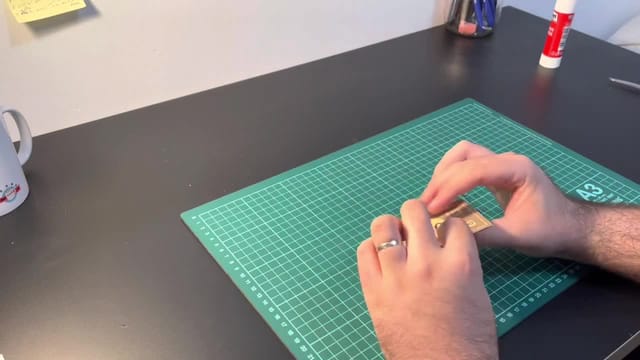
Perspective Monopoly
Two size changes with a prepared paper bill
A Monopoly bill is shown and torn in half. When the pieces are compared, one seems to grow; the other then becomes a miniature. Julio Montoro teaches both the construction of the paper gimmick and the handling that coordinates its movements with the camera.
The apparent change depends on perspective and the distance between the pieces. This is a camera effect with a defined viewpoint, rather than an unrestricted comparison that spectators can watch from every side.
Required design and materials
You need the specific Perspective Monopoly PDF design referred to in the recording, printed paper, scissors, a glue stick and a camera. The design supplies the normal, giant and small pieces required for construction. An ordinary game bill is not a direct substitute. The explanation arranges the pieces to make three gimmicks per printed sheet and explains why the parts are assembled separately instead of relying on precise double-sided home printing.
The recording's reference to the PDF identifies the required material. It does not establish a currently available download link, physical replacements or compatibility with every printing setup. You must have the design and be able to print, cut, glue and rehearse with the camera.
Assembly, orientation and drying
The normal bill and the giant and small pieces are cut out. The large piece is folded and the printed design is oriented before the corresponding faces are glued. The number and semicircle provide reference points so that the gimmick opens in the correct direction. Julio explains alignment and gluing up to the indicated edge, then adds the small piece and marks only the fold needed in that area. The other part is left as it is.
The glue must be allowed to dry before use. The dimensions, printed reference points and direction of the folds are part of the mechanism, not merely decoration.
First change: cover and perspective
The handling is explained from behind and later repeated from the front. The camera occupies the recording audience's viewing position. The sequence starts with the number facing down and the fold that helps the paper tear in the intended area.
Bringing a piece toward the lens briefly covers the movement behind it. Julio explains opening the gimmick and moving the hands away so that the pieces still seem equal in size from that viewpoint. Changing their spatial relationship reveals the apparent growth. Distance and fingertip grip matter: showing too much of the hand would give away the large scale early.
Second change and practice
The large piece again supplies cover while the section producing the miniature appearance is closed. The explanation follows the approach, hidden action and renewed comparison, then repeats the movements from the front. The number must keep a consistent orientation when the pieces are shown again.
Practice combines the folds, approach to the camera, cover, fingertip grip and comparison distances. The lesson teaches construction and both changes under these viewing conditions; it is not a real-money transformation or a card-selection routine. The outcome is an apparent scale change from the planned camera viewpoint.