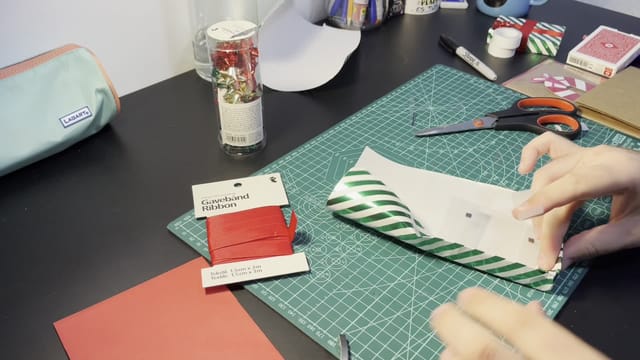
The postcard that wraps a small gift
A deck seems to get wrapped inside a postcard
A postcard is shown flat on the inside. A deck along with some wrapping materials are seemingly placed into it, and after a shake, the box appears wrapped and decorated. Upon opening the card again, its inside can be shown empty from the expected position.
Julio Montoro breaks down the construction and handling of this visual piece with a Christmas presentation. The demonstrated object is a deck; it is mentioned that the idea can be adapted to other small gifts, but the construction is tailored to the size and shape of the specific object.
Materials and three parts of the gimmick
You will need a deck with its tuck case, cardstock or acetate, wrapping paper, decorative ribbon, and a bow or decoration. Two identical postcards, several magnets, adhesive tape, double-sided tape or glue, scissors, a marker, and a ruler or other straight edge for marking are also used.
Julio recommends cardstock and builds the example with acetate because it is what he has available. The identical postcards are used to make the prepared card; it helps if their faces are flat. The decoration stores mentioned are not a mandatory supplier, nor is a commercial magic product needed.
The explanation works through three related elements: the shell that gives the appearance of a wrapped gift, the postcard that allows loading and retrieving parts of the gimmick, and the set of paper, ribbon, and decoration that seems to be introduced for wrapping.
Fabricating the shell and its fastening
The deck is used as a template to mark the face and edge of the cover. Afterward, it is cut out, the tabs are folded, the excess is adjusted, and the edges are secured. The dimensions are tested on the actual box rather than relying on a universal measurement.
The deck is prepared with magnets and put back into its tuck case. Other magnets are placed at the corresponding points of the shell so that both parts attract and stay aligned. Julio checks this connection and comments on how to reinforce it when a single magnet does not hold with the necessary force.
The cover is wrapped with paper and decorated with ribbon and a bow. It is checked again that the fastening works after adding those layers: the exterior finish must preserve the fit needed for the handling.
Preparing the postcard and the wrapping materials
Using the two identical cards, a postcard is constructed that allows opening by different sections. Magnets are placed between the faces, the pieces are glued, and the necessary section of the back is cut out. The explanation reminds you to let the glue dry, although it continues with the example to show the process.
A small set of paper, ribbon, and decoration matching the gift is also prepared. It looks like a group of loose materials held with the fingers, but it is kept together to load and retrieve it within the sequence.
Julio shows how to maintain that irregular appearance of the paper and how to secure the elements so they behave as a single piece. A new wrap is not produced around the box without preparation: the change in appearance depends on these previously fabricated elements.
Load, shake, and display
The handling starts by showing the inside of the postcard and controlling which part opens each time. By pretending to place the deck inside, the shell and its fastening are organized. Then the gift materials are introduced and the action of the hands accompanies the visual transformation.
Upon closing it again, the gimmick allows recovering the appearance of an empty card. The tutorial repeats the sequence with the camera repositioned so the path is understood and points out the viewpoint conditions. You will need to rehearse the opening, the loads, the finger cover, and the angles before whoever watches you.
An optional entry from an envelope is also mentioned, with a load when taking out the postcard. It is an additional handling possibility; the main gimmick is also explained without it.
Handing out the gift and scope of the lesson
If you want to end by giving a truly wrapped deck, Julio suggests putting the set away and switching it for another already wrapped box before handing it out. That out requires having a second deck ready and performing the switch; the shell is not presented as an ordinary wrapper that can be examined without restrictions.
The lesson brings together fabrication, decorative finishing, and the handling of a specific routine. It is useful if you enjoy building props and can prepare the gift, adjust the magnets, and practice the coverage. The Christmas style can be part of the presentation, but it does not replace the conditions of size, fit, and angles that sustain the illusion.