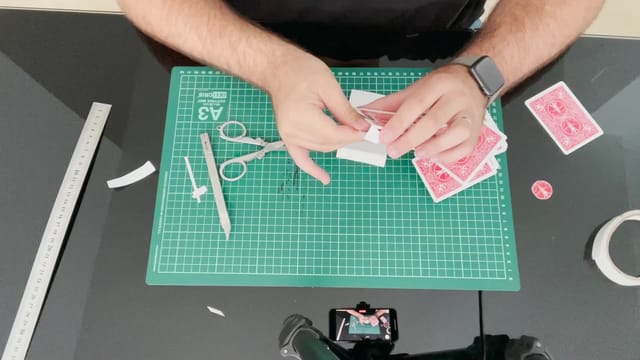
Utility Card Box: Construction and Production of a Card
A Gimmicked Card Box for Various Applications
This lesson by Julio Montoro focuses on crafting a utility prop using a card box. The setup allows you to show the inside seemingly empty and shake it without any sound; then a card is heard inside and produced.
The core of the tutorial is the construction and operation of the device. A simple application is also explained at the end with a card presented as invisible that ends up appearing inside the box. The idea is to understand the prop so you can incorporate it into your own routine, rather than learning a collection of complete tricks.
Materials and Compatibility
A card box, a white sheet of paper, double-sided tape, a utility knife, scissors, and a ruler are used. A card serves as a reference for measurements, and the deck helps shape and fit the gimmick inside the box.
The example works with the Bicycle Rider Back design and matching back cards. That match plays a role in the overall appearance; when adapting another box or design, you will need to check this, along with the size and interior space. These are standard cards and materials to make the prop.
For the application with a selection, you also need the corresponding card and its duplicate. The tutorial explains the preparation of this load as part of the box's operation.
Construction and Interior Adjustment
Montoro demonstrates how to measure and cut the paper so that it fits the interior with little lateral movement. He also shows the preparation of an area of the box, the folding of the paper, and the placement of the tape.
The deck is used as a reference for thickness and to press down the gimmick. The direction in which the paper must be inserted, how to seat it, and what to do if it falls short or sticks out are explained. Trimming excess and removing misplaced adhesive are important details so that cards can continue to slide in and out.
During manufacturing, practical adjustments to the assembly itself arise. The class allows you to follow those corrections and understand the desired result, rather than just giving measurements assumed to be valid for any box.
Showing, Hearing, and Producing the Card
With the box ready, the explanation continues with the load and closure. Montoro reviews how to orient the box when opening it, show the interior, and maintain the necessary cover.
Next, shifting between silence and sound through the grip is covered. The production combines that auditory cue with the extraction of the card. It also shows how to display the interior again and reset the prop after the production.
The box retains its everyday use as a case to carry the deck. The teaching distinguishes that transport from the gimmicked handling used when you want to present the production.
A Brief Application and Possibilities to Develop
The final application starts from a selection directed toward a card for which a duplicate has been prepared. Montoro shows a handling to give the impression of taking the card and making it invisible; the spectator pretends to throw it into the box, first silently and then with sound, and the card is revealed inside.
It is a brief example of using the device. The possibility of producing a banknote is also mentioned as an application idea; a different complete routine with money is not developed.
The lesson is useful if you want to build a utility prop for productions from a card box and work on its integration into card magic. It requires precision in paper and gluing, load and grip tests, and rehearsal of the interior display. The value of the tutorial lies in that assembly and in understanding its conditions of use to create or adapt a presentation.