Nespresso Box Capsule Production
Capsules Emerge from a Seemingly Empty Box
Julio Montoro presents a box of coffee capsules that appears to be empty, closes it, and finishes by producing capsules from the inside. The routine uses a Nespresso box and contrasts the seemingly empty box with the subsequent production. The appearance is revealed by opening it and extracting the capsules after closing it: the effect relies on this sequence of display and production.
In a single tutorial, you will find the demonstration, the construction of the gimmick, and the explanation of how to present it. Montoro uses commercial coffee packaging as starting material and shows the assembly so you can prepare it yourself.
Crafting with Cardboard Boxes
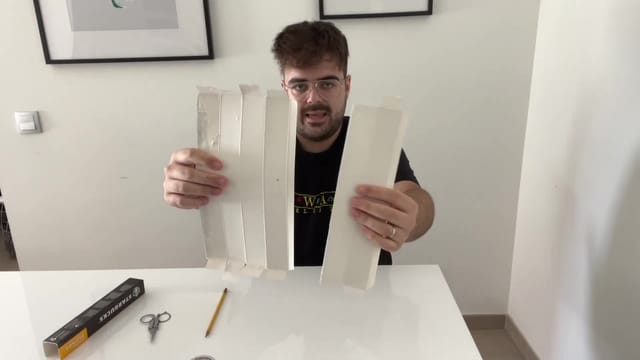
The example is constructed using three capsule boxes. The explanation shows how to carefully open one of them, which parts to use from the others, and how to work the flaps before joining the pieces. The cutouts serve different functions, so learning involves understanding the assembly and the orientation of each part.
Montoro details the alignment of the flaps, gluing with double-sided tape, and positioning the internal assembly. He checks the result as he goes so you understand how the gimmick can be folded and opened. The measurements he mentions are a guide: he indicates that they must be adjusted depending on how your specific assembly turns out.
You will need three suitable boxes to replicate the construction, double-sided tape, and scissors. The capsules to be produced are also required. An empty transparent cup is also mentioned for the performance; however, the instruction focuses on the box and its handling.
Preparation, Loading, and Display
Once the gimmick is built, the lesson continues with loading the capsules and how to carry the folded box at the start. Montoro explains how to open it, hold it by the flaps, and turn it to maintain the impression that it is empty.
Angle management is part of the method. Showing the flat assembly requires care and a favorable viewing angle. You will learn what must remain covered during the turns and why the pacing of those actions matters so the display is perceived as a single, continuous check of the box.
This section requires practicing with the constructed prop: folding, opening, and shifting your grip helps you understand what the audience is seeing. The explanation emphasizes the relationship between the construction and the hands, beyond simply memorizing a sequence of moves.
Closing and Production
After showing the empty box, Montoro teaches how to close it while making sense of the bottom flaps, introducing a pause or a magical gesture, and opening it to extract the capsules. He also shows the final opening with which the sequence concludes.
The demonstration incorporates a humorous patter routine about the price of coffee and George Clooney. You can study how that patter accompanies the display and provides a justification for the magical moment. The technical explanation allows you to separate the handling from this specific presentation and build your own script around the product you use.
Adaptation and Practice
Nespresso serves as the performance example; the packaging shown in the construction is from Starbucks capsules. Montoro notes that you can apply the idea to boxes of other products, such as cookies, and to different sizes. Such adaptation requires reviewing the structure, flaps, and dimensions of the packaging to replicate the functions of the explained construction.
This lesson is useful if you are looking for a production with an everyday object and want to craft and rehearse your own gimmick. It is best to spend time on cutting and gluing, and then practice the load, the cover, and the turns from the audience's perspective. The effect combines this prior preparation with a brief routine in which the box goes from looking empty to delivering its contents.