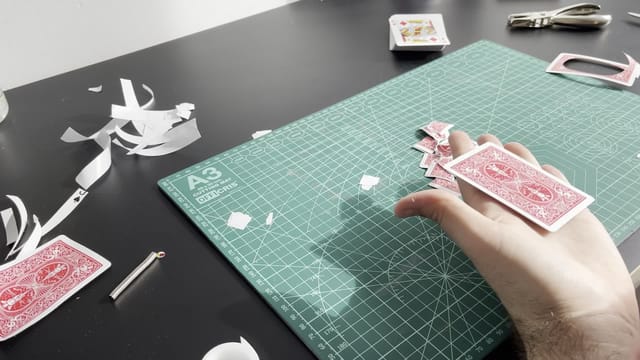
Roto: From many fragments to a whole card
A card torn into many pieces
Julio Montoro starts from a simple idea: someone freely tearing a card need not leave four equal pieces. His construction presents many fragments and visibly turns them into a whole card as the hand passes over them. The lesson develops the accessory behind that image and shows a way to incorporate it into a presentation.
The restored card matches the identity selected in the example. The suggested entry uses a duplicate and a force; restoring a card freely signed by the spectator is not taught. A signature is neither demonstrated nor explained.
Building the magnetic assembly
The tutorial starts with two matching cards for the support. Julio shows magnet placement, layer separation, cutting the frame and gluing the prepared card. He adjusts thickness and reinforcement during construction.
He then builds the piece that looks like accumulated fragments. A base is cut, its size related to the magnetic positions and small card pieces glued on to protrude and create the desired image. This is laborious work requiring glue and drying time; the recording pauses to let the assembly dry.
The explanation continues with cover pieces, magnetic placement and discreet orientation marks. Learn why you must know each part's direction and how they relate during restoration. This is built in the lesson, rather than a finished accessory you must buy.
Restoration, hand transfer and cleanup
Julio shows positioning the assembly in the hand, bringing the prepared card toward it and creating the image of fragments becoming a single card. He then works on the hand-to-hand transfer and removal of the extra piece to finish by showing the restored card.
Orientation and cover matter. Before restoration, the hand must remain steady to avoid revealing that the visible fragments form one prepared piece. The teacher also warns that the initial demonstration's angle is unhelpful. The explanation makes these conditions understandable; this is not a restoration visible from any position around the magician.
A suggested entry to the restoration
Construction and the visual change are developed in detail. Julio initially leaves the entry as a creative task, then proposes forcing another card of the same identity, letting it be torn, switching the fragments and retrieving the prepared card when going to the pocket. He tests and changes that sequence during the explanation.
This is therefore a suggested integration using palming, switching and loading, not a forcing course or one fixed complete routine replacing the work of adapting an entry to your handling. Confidence with palming and managing attention during those actions is advisable.
Materials and ending conditions
You need the matching construction cards, another of that identity for the suggested selection and tearing, additional cards for bases and fragments, small magnets, ordinary and double-sided tape, a glue stick, cutting tools and something for orientation marks. Drying and adjustment are necessary; instant construction is not promised.
After cleanup, Julio limits final examination to a brief showing. The prepared card is not offered as an ordinary card for prolonged, unrestricted inspection. This project suits those who want to build a highly visual restoration of numerous fragments and understand the mechanics, cover, orientation and presentation decisions it requires.