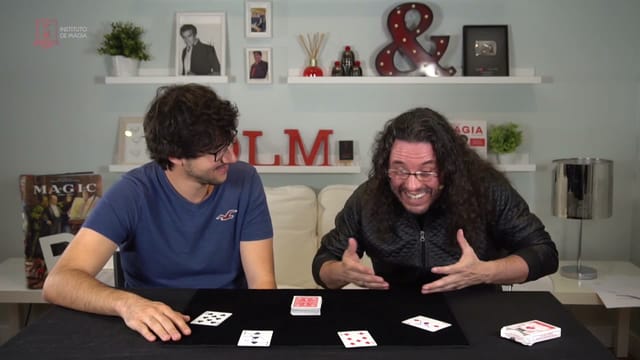
Invoked Cards: Kings, Aces, and Card to Number
A routine built around the Jennings Aces
Hernán Maccagno presents his take on the classic Jennings Aces under the title Invoked Cards. A fantastic patter about the rituals of each card unites three blocks: calling the kings by name, producing the aces, and locating a numbered card based on the participant's choices.
The masterclass includes the full performance, a reflection on revisiting foundational tricks with accumulated experience, and an explanation of its construction. The real value lies in turning a straightforward procedure into a multi-phase routine with a connecting plot.
Kings and Aces: Two Linked Revelations
The setup uses a partial stack of the deck. You will learn how to maintain it while the spectator shuffles other groups, trades packets, and participates in cuts. We examine the difference between what actually happened and the false memory of a shuffle built through your actions and patter.
Spelling is incorporated as part of the ritual leading to the production of the kings. We study the instructions for forming and handling four packets, the layout of objects on the table, and the separation of actions that could otherwise be confused.
The production of the aces stems from what came before and uses a gambling theme. Attention is paid to the order of the revelations and the matching suits between the kings and the aces. The text highlights key moments so that the second phase reinforces the first.
The Card to Number and Finale
The next block uses a high-value numbered card and several values chosen by the spectator. We explain how to adapt the procedure to the named value, prepare the necessary groups, and conduct the counts. The calculations are blended with questions and actions that give a logical motive to the participant's actions.
The explanation reviews the conditions of the selection and corrects a calculation from the initial example. Then, the process is repeated with another card to trace its mechanics. The final position arises naturally from the values used in the routine; it is not presented as a freely named card and number.
Pauses help the spectator remember having handled the cards themselves right before counting down to the revelation. The finale brings back the kings and ties them once more to the aces of their matching suits, providing a cohesive conclusion to the previous blocks.
Materials and Prerequisites
You need a complete regular deck, including its four kings and four aces, and a table with enough room for several packets. The partial stack is taught in the class; it requires no special gaffs or props from another trick.
It is helpful to be comfortable maintaining an ordered block with cuts, holding a break, and performing clean counts. The main challenge is coordinating the setup, simple math operations, instructions, and presentation without losing the thread of the phases.
The thought-of card and additional spelling variants are mentioned as possibilities from an external text. The practical teaching developed here is the exact sequence performed and explained with the participant.