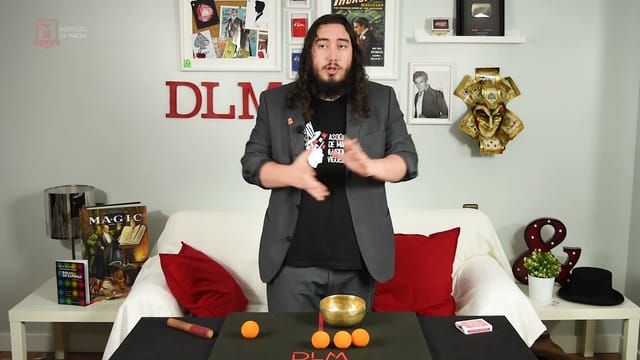
Tibetan Singing Bowl and Sponges: Roy Benson's Routine
A Tibetan singing bowl, its sound, and silence shape this version of Roy Benson's routine. Sponge balls vanish, reappear beneath the bowl, and travel to a spectator's hand. The production of a deck of cards concludes the sequence. Xulio Merino introduces the effect and breaks down its technical details, the acting behind the actions, and the pacing of each reveal.
Two false transfers and their performance
The masterclass covers the roll down (a rotational false transfer) and the premeditated Xuliana vanish. Each sleight is explained in detail, paying close attention to finger positions, sponge compression, finger palm, and hand relaxation.
We analyse the psychological impression conveyed by each handling: a casual action performed while reaching for another object, a more deliberate placement, or a presentation featuring a red herring. Actions in transit, gaze, and attitude are worked on alongside the mechanics to give the sequence complete naturalness.
The effect in the spectator's hands
A significant portion of the explanation is dedicated to audience participation. We study which hand to ask for, how to give instructions, and how to guide the closing of the spectator's fingers naturally. Minor adjustments the volunteer might make and how to maintain clarity in those situations are also discussed.
The sequence progresses until the spectator finds two balls and then three in their hand. Xulio explains how to build expectations and allow time to savour each surprise before moving on. Pauses and patter help separate the phases and build up to the climax.
The complete routine and props
The explanation covers the setup, the placement of the props, the travels to the bowl, spectator participation, the final load, and clearing away. We review the differences between the actions of each phase, viewing angles from below, and body coordination when handling the props.
You need four sponge balls of the same colour, a bowl or container that can hold three without jamming, a wand-like object, and a final load that fits inside. The version demonstrated uses a singing bowl, its striker, and a deck of cards. A mug and spoon are also discussed as an alternative presentation.
The setup requires a table and accessible pockets for the props. The sleights are taught starting from their initial positions; mastering the routine demands practising hand coordination, finger palm, and interaction with the volunteer. It is best to practise the moves slowly at first, then integrate them with patter, pauses, and audience reactions.