Loops: Handling and Effects with Invisible Elastic Thread
Working with invisible elastic thread in a loop shape
Adolfo Masyebra explains his approach to using loops in close-up magic: small loops of invisible elastic thread that allow you to animate or levitate objects. The class combines an extensive first section on the material and performance conditions with the development of three practical effects featuring glasses, a card, and a fork.
Choosing the thread and knowing its limits
Different compromises between visibility, elasticity, and strength are compared. Adolfo discusses Yigal Mesika's Loops and his own RBI Plus material based on his performance experience, explaining why he does not always choose the same thread for every situation. The goal is to match the material to the object's weight, handling, and environment, without assuming any thread is completely invisible or unbreakable.
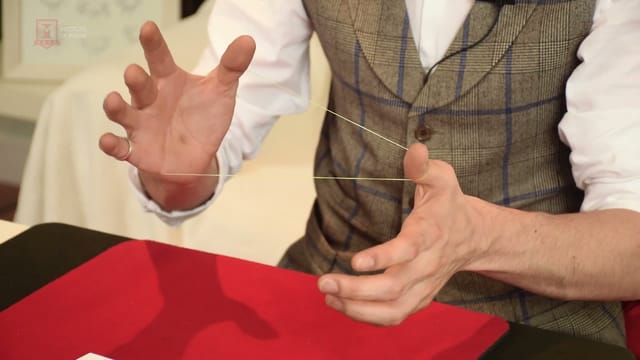
A thick, visible elastic loop is also used for the learning process. This resource allows you to study the positions and understand what happens before moving on to performance-grade material. Emphasis is placed on testing the tension, recognizing the limits of the thread, and getting familiar with it through practice.
Lighting, backgrounds, and environmental control
The theory is applied to concrete decisions: where to position yourself, what background your clothing provides, what surface lies beneath the object, and from which direction the light arrives. It explains how the shadows of your hands, arms, or head can serve as cover and why each setup exposes different areas.
Situations that can alter working conditions are also discussed, such as a camera with a flash, a new light source, or spectators changing positions. The class teaches you to evaluate when it is best to adapt the effect, look for another location, or choose a different type of magic. It does not present a handling that works equally well under any lighting and from all angles.
Another section covers breaks and what happens if someone spots the thread before, during, or after the effect. Adolfo shares his criteria for closing the sequence, abandoning that method, or moving on to another routine, without promising that these situations can always be avoided.
Rising glasses
The first effect uses a pair of glasses on a table and serves to study anchoring, elevation, and body cover. Small changes in position and the usefulness of shadows are compared, alongside the relationship between visible movement and the performer's gesture.
The explanation pays close attention to the borrowed object: how to receive the glasses, assess their balance, and set up a suitable surface. Differences in weight, temples, and lenses that can make handling difficult or cause the owner to fear scratches are discussed. A close-up pad or handkerchief allows you to prepare a more appropriate surface.
This effect also serves to compare a spoken presentation with one supported entirely by silence. You will work on the clarity of the magic gesture and the possibility of letting the spectator observe and interpret the movement without constant explanation.
Floating card
The second application develops a brief business card levitation. A sequence based on a static electricity fiction is presented, and the handling is explained using visible elastic before repeating the details with the performance thread.
The preparation of the card, its curvature, the support, hand positioning, and the recovery at the end are studied. The class addresses trembling, the relationship between movement and presentation, and the adjustments required for different weights and resistances. Credit cards are discussed as an inconvenient option due to their weight; a lightweight business card allows you to practice the described handling.
The duration of the effect is also part of the teaching. Adolfo proposes a brief, clear image and explains how the interpretation changes depending on the character: a prolonged levitation and a minimal telekinetic-looking movement do not communicate the same thing.
Moving fork
The third application develops the animation of a fork on a surface. Anchoring, the position of the cutlery, the start of the movement, and the exit are explained, with details on how to avoid unwanted shifts.
The presentation works on the opposition of the hands and the relationship between gesture, breathing, expression, and the object's movement. Different ways of interpreting the effect are compared, showing why the table background has a different importance here compared to the cover used with the glasses. Adjustments for left-handed performers and the influence of the cutlery's finish on the thread are also discussed.
Materials, practice, and scope
You will need loops or loops of invisible elastic thread suitable for magic, several backups for rehearsal, a thicker visible elastic to study the handling, glasses, lightweight business cards, and a well-finished fork. Add a table or work surface, a close-up pad or handkerchief, and clothing whose background you can test against the lighting you plan to use.
The handlings for the three applications are explained, but you will need to practice them with your own objects and test weight, tension, lighting, and angles. The training combines fundamentals and applications; it is not a complete catalog of positions or a thread-making workshop.
Ghost touches, the haunted deck, and other uses are mentioned as possibilities. The practical development of this recording focuses on the glasses, card, and fork. References to books, his own videos, and other materials are supplementary study resources and not included in the class.