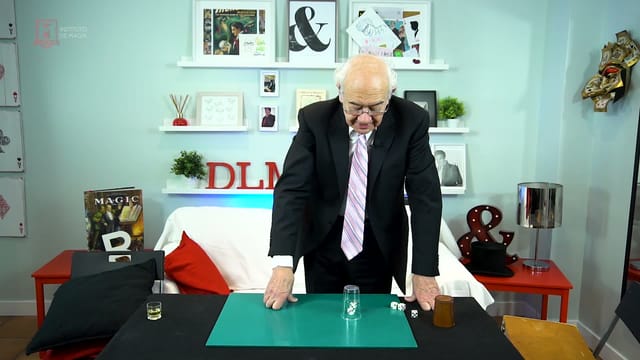
Dice and Whiskey: Travels and Stacking with a Dice Cup
Five dice travel from hand to hand, are scooped up with a dice cup, and lead into a sequence of stacking and productions. Camilo Vázquez presents Dice and Whiskey and breaks down the sleights of his routine, the requirements for the props, and alternatives to adapt it to different settings. The dice serve as objects that travel and appear; their pips do not affect the plot.
Hand-to-Hand Travels
The first part adapts coin sleights to dice handling. The click pass and Han Ping Chien are taught, along with the palm of multiple dice and the coordination of sounds with movements.
You will study how to link the travels, introduce a change of pace through a joke, and clearly signal the end of the phase. Specific explanations are given for grip details and finger releases when working with objects of this shape and size.
Scooping and Stacking
Working with the dice cup starts with scooping a single die, moves on to several, and progresses into stacking. The rhythm of the movement, seamless scooping, the pause, and the technique for lifting the cup without knocking over the column are explained.
The explanation also uses a transparent glass to demonstrate what happens during the move. The sequence connects the apparent passage of a die through the table with the revelation of four stacked dice, setting up the finale.
The Climax and Alternatives
For the featured version, the tutorial explains the production of a small glass filled with liquid, its loader, and coordination with body movements. The presentation covers the preparation of the gimmick and its handling within the routine.
If you choose not to prepare that climax, alternative objects that fit inside the dice cup are suggested. It also discusses how to adapt the presentation when the props allow for scooping but do not offer stable stacking. These alternatives retain part of the journey with adjustments to the final effect.
Props and Practice
You will need five dice, a dice cup capable of stacking, and a rigid surface. The instructor recommends regular-geometry dice for practice and compares casino models, standard dice, and other sizes. The cup must accommodate the intended column with some extra height clearance.
For the liquid finale, you also need a small glass, the explained pull loader with a stopper and cord, and clothing that allows you to load it as demonstrated. Combining palms and stacks requires gradual practice: first the scoops, then column stability, and finally the complete routine with its rhythm and patter.