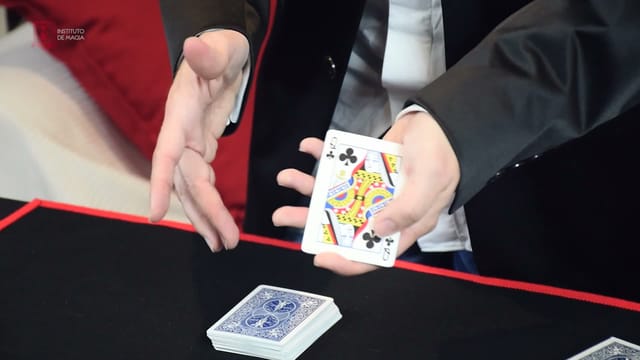
Wiggle Displays I: Ascanio's Spread and Turning Queens
Arturo de Ascanio's wiggle display is studied as a way to show the cards with clarity, smoothness, and continuity. Miguel Ajo introduces its origin and movement philosophy before breaking down the positions, spreads, and a complete application featuring the four queens.
Sleights, Grips, and Naturalness
The explanation begins with the three-card wiggle display and moves on to the classic four-card wiggle display. You will practice the ring finger grip, the spread, and Bernard Bilis's one-handed variant, with alternative handlings to help you find a comfortable execution.
The emphasis is on coordinating your fingers without stiffening your hands, spreading the cards with a fluid motion, and avoiding exaggerated wobbles. Horizontal plane visibility is also analyzed: how to angle your wrists when performing seated and how to present the cards when standing. Each spread is integrated into a subsequent action, such as a display, a gesture, or closing the packet, so the handling has direction and does not become a repetitive movement.
Turning Queens and Color Changes
The routine is performed for a spectator and then broken down phase by phase. The queens turn over as they are named, right themselves, and lead into color changes on their backs, featuring a multicolor finale.
We cover the patter, transitions, assimilation pauses, and integrating the packet with the deck. The principle of maximum synchronicity and actions in transit help coordinate attention and gestures. The explanation incorporates the Hamman Frustration Count; the Stuart Gordon Turnover appears as a quick finishing option. A continuous run-through brings the sequence and its final cleanup together.
Props and Practice
The featured version uses a blue-backed deck, four queens with different colored backs, and a red/blue double-backed card. Other color finishes or messages are also suggested as presentation alternatives.
This is demanding card magic: you should be comfortable handling small packets, breaks, and double cards. The wiggle displays are explained starting from their initial positions; precision in the grips, position changes, and the flow of the routine require unhurried practice. Also practice from the spectator's point of view, paying attention to visibility and the rhythm of your displays.