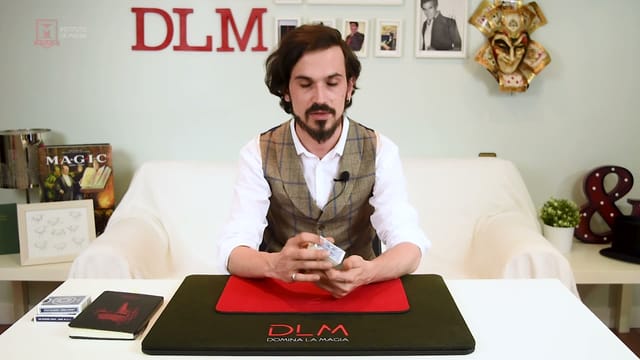
Haunted Deck: The Haunted Deck
A chosen card is lost in the deck; the deck begins to move and the selection eventually rises out of it. Adolfo Masyebra presents the Haunted Deck and develops handlings designed to maintain a natural relationship with the cards before the animation.
Two Handling Approaches
The explanation starts with a hookup presented through the gesture of hypnotizing the card. A simpler control sequence is studied, along with a more technically elaborate one that incorporates cuts, shuffles, and a ribbon spread. The movements are repeated with visible thread to make it easier to follow the actions.
A more discreet and sensitive hookup alternative is also explained, tied to receiving and placing the card. The focus is on coordinating the fingers, pressure, and transitions without introducing moves foreign to standard card handling.
The masterclass briefly compares a version using Yigal Mesika loops. At the end, the instructor demonstrates his personal version and discusses his overall journey; it serves as an example of applying the ideas developed.
Tension, Movement, and Climax
An important part of the work consists of understanding and feeling the tension of the thread. Small adjustments to the deck, hand symmetry, and the progression of the movement are analyzed to give the animation continuity.
The climax receives a specific explanation: the goal is to accompany the rising card and preserve the feeling that it wants to leave the deck. It also covers how the number of cards the thread has to move influences the effect, and when it is best to stop the movement and adapt the revelation.
The presentation includes the attitude during the handling, the confidence built through rehearsal, and a final reflection on presenting these phenomena as magic, without selling supernatural powers.
Materials and Practice
You need a standard deck, invisible elastic thread prepared as a loop, and a close-up pad on a table for the explained handlings. The instructor recommends blue backs with a recognizable design and shows common deck models; these are working preferences, not a requirement to use a specific brand.
To begin studying the hookups, he suggests using regular sewing thread, which is easier to see. Familiarity with loops and fluency in cuts, shuffles, and spreads is helpful: the Charlier cut appears within the sequence, without a general explanation from scratch. Learning requires practicing sensitivity to tension, angles, and the coordination of both hands before integrating the effect into a performance.