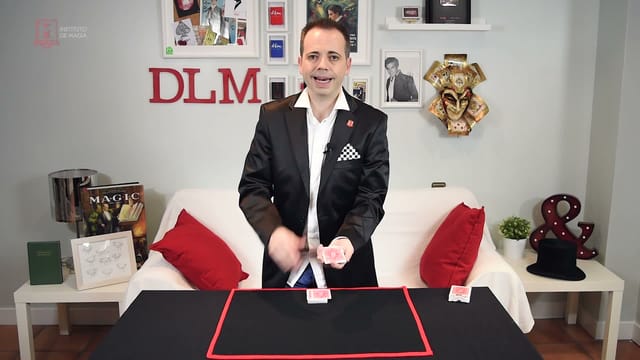
Tenerife and Las Palmas Wiggle Displays: Oil and Water
Wiggle Displays and Ascanio's Displays
Miguel Ajo develops variations of the wiggle display that allow packets to be shown smoothly and set up various continuations. The explanation begins with Tenerife and Las Palmas, and is completed with the Sincere Display, a different sleight that shares the quest for naturalness and visual clarity.
In Tenerife, you study the turn, the space needed to work without snags, and the final indirect pinch grip. In Las Palmas, versions with and without a prior break are compared, along with their application to multiple groups. Attention is paid to touch, the ring finger grip, and the stability of the cards during movements.
The Sincere Display is analyzed separately, featuring a safety alternative for groups that tend to get misaligned. It explains how to maintain a symmetrical and relaxed appearance without introducing unnecessary tension in the hands.
Application to Oil and Water
The second part presents a multi-phase routine in which red and black cards are mixed and separate once again. It includes a performance, a detailed explanation, and a complete review of the sequence, with the final kicker known as Don't Blink.
You study the packet preparation, the displays, the interlacing, and the various revelations. The wiggle displays are linked to other sleights used in the routine, such as the Elmsley count, the angular turnover, and the double lift. Alternatives are offered at certain points to adapt the handling to the student's fluency.
Clarity, Pacing, and Attention
The technical work is accompanied by an analysis of what the spectator perceives. The patter about the densities of oil and water helps mentally picture the effect before showing the separation.
You study assimilation pauses, moments of relaxation, actions in transit, and misdirection toward what matters in each phase. The main moment of the effect is also distinguished from subsequent verifications, and you learn how to avoid abrupt changes in pacing when handling or gathering the cards.
Materials and Practice
You need an ordinary deck with enough red and black cards to set up the explained packets and a working surface. The displays are performed without adhesives or gaffed cards.
It is recommended to master basic packet handling, wiggle displays, and the Elmsley count. The study requires precision with double and triple groups, breaks, and the double lift. Practice each sleight and its starting positions first; then link the phases while maintaining the same clarity and naturalness as in the honest actions.