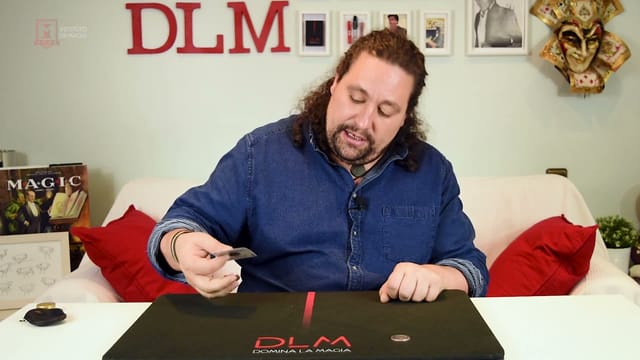
Free Flight: Three-Coin Flight
Three Journeys Toward a Leader Coin
The routine begins with four coins. One is set aside as the destination while the other three travel to join it, using a single playing card as cover. The final journey brings in the spectator, who helps reveal the end result.
Miguel Ángel Gea presents his handling of Paul Harris's Free Flight. The lesson breaks down the sleights and, above all, the relationship between movements, performance, and audience attention. Choosing the leader coin introduces the premise; ways to give it personal meaning through a story or a representative object are also discussed.
Sleights Within Continuous Action
A sequence by Ross Bertram, a click pass by Michael Rubinstein, and Slydini's false take are studied. The instructor explains hand positions, retention, sound, and hand coordination, comparing the standard methods with the modifications he uses to link them more smoothly.
Action in transit is central to the handling: every movement must lead into a task the audience can easily follow. The lesson covers how to pick up the card, retrieve or drop coins, and proceed without pauses that look like a technical setup. Details are also examined to prevent accidental noise and keep the hands relaxed.
The structure aims to avoid a predictable cycle of sleight and revelation. You will learn how to leverage the anticipation of a coin's arrival so the next journey flows naturally, rather than mechanically repeating the same pattern.
What the Audience Should Perceive
The theoretical section proposes separating the image of the effect from the hand performing it. Gea analyzes the language used, the attention directed at the hands, and the possibility of using a card or a fantasy presentation to shift the focal point. A brief production and vanish routine with a small cape illustrates this idea.
The individualization of the coin is also emphasized: the vanish must feel like its own distinct moment, rather than just the logical conclusion that there is now one fewer coin. The magic gesture and the performer's attitude tie directly into this goal.
Finale, Props, and Practice
The climax is explained with special attention to the assistant's role, instructions for covering the coins, and reclaiming the audience's attention. Potential participant reactions are discussed, along with the importance of reviewing which word, gesture, or pause might have sparked doubt.
You will need four ordinary coins, one playing card, a table, and a spectator. The cape example is a theoretical aid, not a required prop for Free Flight. It is helpful to be comfortable with palms and false deposits; the specific handlings are explained separately.
Rehearse the passes first and then the sequence along with its patter. Check the final picture from a distance: all four coins must be clearly visible so the audience can recognize the assembly without having to deduce it.