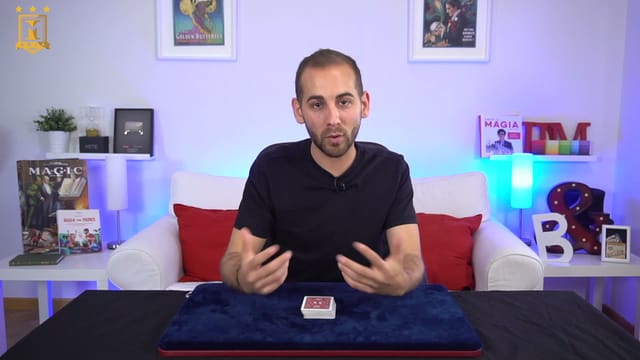
Actions in Transit: Structure, Attention, and Joker Sandwich
Víctor Piña examines actions in transit through the lens of Arturo de Ascanio's structural conception of magic. A secondary action makes sense because it leads naturally into another that the spectator expects. The masterclass combines this analysis with coin and card examples, a full sandwich routine with two jokers, and a construction exercise featuring two solutions.
Contrast, Memory, and Separating the Trap
The starting point is the contrast between the initial and final states. To appreciate a vanish, the audience must retain a clear mental image of what was there before. If too much patter or waiting separates the two moments, the contrast can be weakened.
A distinction is made between the parenthesis of forgetfulness—which helps isolate the secret work from the effect—and the anti-contrast parenthesis, which blurs the clarity of the initial situation. Duration alone does not solve the problem: what matters is what the spectator remembers and where their attention is directed.
A Secondary Action with a Recognizable Purpose
A coin and a pen used as a magic wand serve to break down the sequence. The need to pick up the wand justifies freeing up a hand. The gaze anticipates the target, allowing the coin transfer to happen in the background.
Piña compares this handling to performing isolated actions that the spectator cannot connect. He also demonstrates why it is best to first establish a clear image of the coin inside the hand; that reference later supports the vanish. The example focuses on the construction of the effect and audience attention.
The Bluff Control and the End of a Sequence
Lightning and Thunder allows us to examine what happens when a secret action coincides with the endpoint of a movement. The simulation of a packet using a single card, the spread distance of the dribble, and the tilt that hides the thickness are all broken down.
The suggested solution, attributed to Gabi Pareras, extends the sequence with a fan and an invitation to imagine where the card might be. This concluding action routes the attention elsewhere and alters the weight of the control. It is a classic example of how to re-evaluate the structure of a sleight rather than simply executing it faster.
Economy and Double Function
Adding actions also comes at a cost: it can multiply the moves and scatter attention. Piña suggests verifying whether the maneuver truly needs that cover. Theory functions here as a tool to ask questions about clarity, contrast, and economy.
Double function connects an internal purpose—solving or protecting the method—with an external function that enhances the effect. A single action can fulfill both, provided its purpose remains understandable within the context of the performance.
Lightning and Thunder: A Joker Sandwich
Two jokers are introduced as fast-moving characters that vanish and reappear in the deck, trapping a chosen card. The patter establishes their personality and sets up the surprise to come.
The explanation covers the initial setup, Lennart Green's top shot, and obtaining a break under two cards. The pinky count is compared to a push-off alternative, focusing on the visible intention each handling projects. The apparent pick-up of the two cards, control of the thickness, and continuity when squaring up are also studied.
The selection uses a force with a break and a change of plane. The instructor explains the coordination of both hands, approaching the participant, and the moment to reveal the card's identity. This necessity directs the attention and covers the actions that complete the sandwich. The eyes, body, and field of vision are coordinated so the vanish of the jokers is revealed at the chosen moment. A brief pause is left to let the journey sink in before showing the trapped card.
Exercise: Loading a Card Between Two Jokers
The challenge consists of loading a card and separating the jokers from the deck using a meaningful action in transit. The first solution takes advantage of handing the card box to the spectator to check that it is empty. The second uses the request for them to place their hand over the cards.
Both solutions stem from a goal of the effect and create a justification for the secondary action. The exercise invites you to explore other possibilities and evaluate whether the added cover genuinely improves the trick.
Materials and Requirements
Use a standard deck with two jokers, or substitute them with any recognizable pair. To reproduce all the examples, you will also need a coin, a pen or wand, the card box, and a table. You should be comfortable with breaks, double cards, shuffles, and cuts. The top shot and pinky count receive technical breakdowns, but require dedicated practice to integrate them naturally into your routine.