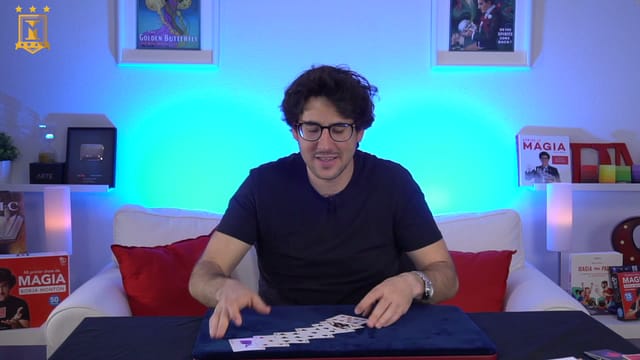
Interactive Seven-Card Magic
This masterclass explores how to build and perform a card trick where the entire audience participates at the same time. Each spectator follows a set of instructions with seven cards and ends up keeping just one. Borja Montón performs the routine, explains how it works, and compares different ways to organize it according to the audience and presentation.
A Routine That Happens Right in the Spectator's Hands
The opening performance can be followed right from home using seven cards. It's framed as a mini magic lesson: shuffling, spreading, and cutting. Then comes a process of elimination where every participant is left holding the exact card they merely thought of.
In the explanation, we dive into the mathematical principle behind it all, the role of the key card, cuts, and the Down-Under deal (Australian shuffle). You'll see why the order of actions matters, even when it feels like everyone is making totally free choices. The initial shuffle, the dealing sequence, and the elimination steps must flow as one cohesive procedure—you can't just swap them around on the fly without breaking the effect.
Borja also uses seven cards featuring colorful butterflies. These are great for showing how to adapt the routine for the stage or parlor, though you can easily practice with a standard deck. The design, colors, and printed text can make the instructions much clearer and turn the final card into a great souvenir.
Clear Instructions and Common Pitfalls
A major part of the session focuses on audience management. We cover how to make sure everyone has their props ready, how to pace the timing for each action, and how to clearly distinguish between the first card, the second, the top, and the bottom.
Borja breaks down common mistakes, like mirroring a move the magician makes that wasn't actually part of the instructions, placing a packet in the middle instead of the bottom, or confusing "take the second one" with "take two." The opening demo is also used to talk about these potential slip-ups and how frustrating it can be for a spectator when a long procedure goes wrong at the very end.
When performing for kids, we look at enlisting adult help and simplifying the handling. The sleight of hand involved, the clarity of the demonstration, and the pacing are just as important as the math. You've got to rehearse the method using the exact patter you plan to say out loud.
A Different Outcome or the Same for Everyone
This section compares a version where every person remembers a different card with one where everyone arrives at the exact same image. We analyze how the climax changes: when spectators look at the people next to them and realize they all got the same result, it makes the collective impact hit that much harder.
We also explore an alternative using full cards, choices between different numbers of discards, and a count of seven tied to the days of the week. Plus, we touch on a streamlined version with fewer actions at the end. Each variation has its own quirks, and the breakdown helps you understand them before you start customizing your patter.
Woody Aragón's "Ritual of Love" is brought up as a reference for design and comparison using torn cards. The main focus here remains on the full seven-card variations Borja teaches, rather than presenting Woody's routine as a full bonus lesson.
Presentation, Props, and Preparation
In the sample presentation, the eliminations are tied into leaving negative situations behind and holding onto hope. We examine how to infuse the process with emotional weight, add some comedy, and craft a memorable, shared climax. It's a scripting framework you can easily tweak to fit your own act.
To practice, you just need seven cards. To perform it live, prep a stack of seven cards or props for each spectator—and if it helps, use a rubber band to keep each packet together. The custom printed cards and their design aren't included as downloadable files; they're a production choice you'll need to sort out yourself before the show.
You don't need any knuckle-busting sleight of hand. However, you do need to nail the sequence, test out the different variations, and master group coordination. Sourcing the materials, bagging the packets, ensuring the cards are easy to read, and tailoring your instructions for kids are all key parts of prepping the routine.