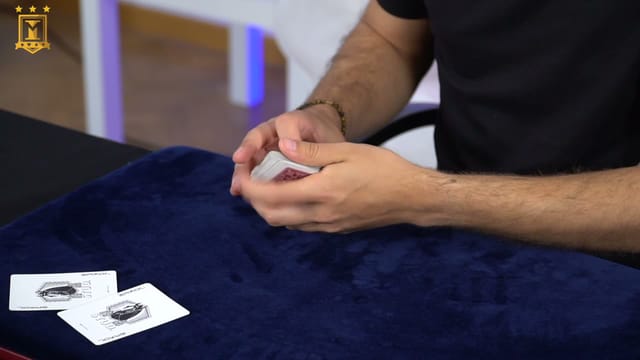
Single and Multiple Debex: Technique and Matching Routine
Víctor Piña breaks down two handlings of the debex, the sliding of a card from underneath a spread. He compares the work of the left and right hands, explores multiple card control, and applies the sleight to a matching routine that begins with a spectator-shuffled deck.
What the Debex Solves
This technique allows you to separate cards within a spread and maneuver them into a useful position without overtly interrupting the search. Both an isolated card and a group of cards are examined. The instructor emphasizes choosing the handling based on the routine's needs: knowing a versatile tool doesn't mean you have to use it in every single trick.
The instructions are demonstrated for a right-handed performer. The functions of each hand are distinguished to understand what produces the shift, what holds the cards, and what movement the spectator perceives.
Left-Hand Handling and the Accordion Spread
The spread is opened and closed with a steady rhythm. This movement allows the separated card to cease being exposed without appearing to vanish from a stationary spread.
The left thumb maintains contact with the card immediately above the one you want to shift; the middle and ring fingers contact the target card from underneath. The coordination between the thumb's retraction, the closing of the spread, and the reception of the card by the right hand is analyzed.
The index finger helps hold it as the spread continues. The position of the receiving hand and the pressure on the upper area prevent an edge from sticking out. Piña repeats the action rhythmically and slowly, suggesting practicing with a reversed card to better see its path. That inversion is a practice training aid, not a performance condition.
Multiple Cards and Consecutive Cards
The handling is expanded using the aces distributed throughout the deck. Each new card must be incorporated underneath the already separated ones, between them and the hand, without opening up a gap that exposes the group.
Tactile perception of the shift and the exact moment when the spread can continue are practiced. When the cards you want to bring together are adjacent, the pressure must be adjusted, and the condition of the deck becomes especially important. Piña explains this scenario and points out the practical limit of a handling that requires repeatedly opening and closing.
Right-Hand Handling
The second option uses a more uniform spread. The left thumb keeps its reference on the top card, while the right middle and ring fingers shift the sought-after card.
This is presented as a useful alternative when you need to gather many cards, such as those of a single suit or color. Multiple production is demonstrated with the aces. The analysis dwells on the risk of losing contact when picking up another card: if the pressure relaxes, the hidden group under the spread might open up. Placement is also learned by touch, since part of the handling takes place out of the performer's own sight.
Matching Routine and Four-Card Gathering
The spectator shuffles the deck. The magician sets aside one card, deals until stopped, and offers a choice between one of two packets. The set-aside card reveals a value that leads to the appearance of the four cards of that same value.
The explanation begins during the removal of the jokers. This search provides a context for locating a nearby pair of matching cards. The debex allows you to handle an intermediate card, reorganize the necessary ones, and set up the trick during the interaction.
The placement of the pair according to its value, the overhand shuffle, and the use of an in-jogged card to keep a reference are all covered. It also explains what to do if another card of the chosen value appears within the cards shifted during the setup: the debex lets you remove it and readjust the distribution. You don't have to always repeat the same value.
The prompt to stop the dealing is introduced once the necessary cards have already passed. Afterward, a question about the two piles shifts the focus from the procedure to the choice. Both possible spectator responses and the order of the reveals in each case are explained. Piña compares their pacing and clarifies that the color match in the demonstration was purely circumstantial.
Materials and Practice
You need a standard deck in good condition, including jokers to replicate the opening presentation, and a surface to deal the packets onto. The search and removal of the jokers are also shown in the hands. It is helpful to know the spread, breaks, and overhand shuffle.
Practice starts with one card and progresses to several, maintaining fluidity and avoiding extra force to compensate for a bad position. The instructor suggests incorporating the debex into your regular practice: whenever you need to locate a card to practice a trick, you can use that moment to bring it to the required position using this technique.