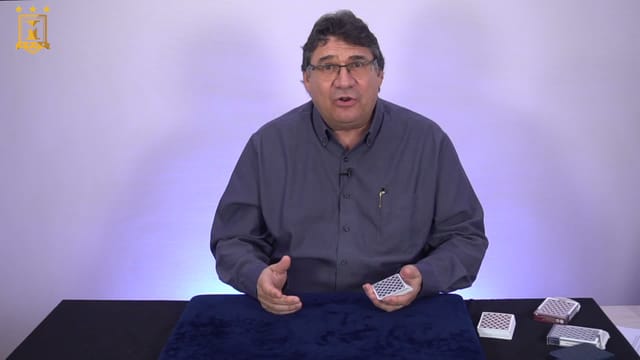
The Spectator's Memory: Construction and Recollection of the Effect
Roberto Giobbi studies how the spectator remembers and reconstructs a magic trick. The lesson organizes five strategies—adding, anchoring, changing, erasing, and shifting information—and connects them to concrete decisions in presentation, handling, and participation. The goal is for the construction of the trick to sustain the wonder both during the performance and when it is recounted afterward.
Recollection as Part of the Structure
Giobbi uses a working model that distinguishes between ultra-short, short-term, and long-term or communicative memory. It helps him analyze three moments: what is experienced during the trick, what is reconstructed shortly after, and what is told to another person.
The initial situation must remain clear enough to contrast it with the final situation. At the same time, certain details of the procedure may lose importance. From this perspective, words, pauses, gestures, and objects on the table participate in the construction of the recollection.
Adding Information: Spelling a Name
A location trick uses the name of a spectator's aunt as a personal hook. The presentation transforms a spelling into a small story with participation and an apparent initial mistake.
The principle of reverse-count placement is explained: repeating a count or a spelling allows you to locate and reveal a previously controlled card. The analysis focuses on how the emotional bond and the repetition of the idea of thinking of someone can foster a broader recollection of what actually happened. The divination of the name is studied as a potential spectator reconstruction.
Anchoring Conditions with Participation and Props
To reinforce the recollection of a shuffled deck, Giobbi chains together different handlings and brings in the spectator. He explains a combination of shuffles that preserves a stack and relates it to a stop trick based on eights and nines. The Faro shuffle used in that combination does not need to be perfect throughout the entire deck.
The core idea is that saying, showing, and making them participate can reinforce one another. The "waiter theory," attributed to Gabi Pareras, is also developed: the final arrangement of the objects helps reconstruct what happened. A card next to its card case or a deck that visually retains the trace of a cut serve as recollection positions. The gaze and the moment of squaring or gathering complete that function.
Changing Information Through Recapitulation
A demonstration of choosing, returning, and controlling a card allows for the study of how the sequence is reconstructed. Giobbi uses a reference via a key card or guide block, presents a handling with a bridge, and explains an "accidental pass" while squaring the spread.
The analysis distinguishes the images worth fixing from the moments that fade into the background. Afterward, a verbal recapitulation accompanied by gestures can suggest a way of returning the card different from the one actually used. The continuity of the words, the clarity of the actions, and body language are examined; technical control and its presentation are worked on as parts of the same construction.
Erasing and Shifting Details
The cups and balls example illustrates how a general expression, such as setting an object aside, avoids verbally insisting on a specific destination. The analysis focuses on the recollection of the actions.
To study the shift of information, Giobbi starts with four prepared aces, shuffles, and then has the spectator cut and shuffle other packets. The presentation links those interventions and makes it possible to analyze to whom each shuffle is attributed when remembering the whole. This setup is presented as a starting point for ace routines.
Material, Practice, and Bonus Video
Card magic examples use a deck, a table, and, in one case, the card case. It is convenient to handle shuffles, cuts, breaks, and basic controls so you can concentrate on their function within the trick. You can practice by identifying what the audience needs to remember in a routine you already know and reviewing which actions reinforce that recollection.
The bonus video presents Sharing Secrets as a reference to dive deeper into practical theory and discusses its organization by concepts and examples. It includes tips from the author on studying magic literature in English. The book is discussed as supplementary reading.