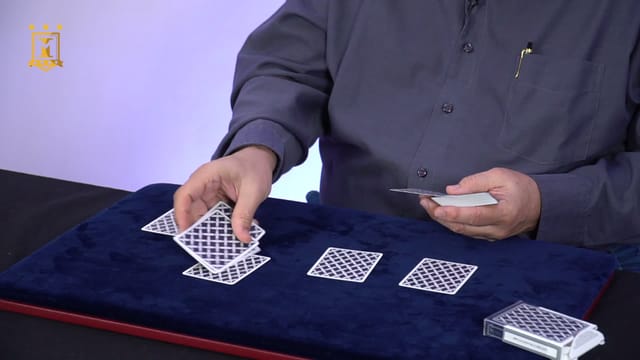
Implicit Conviction and Aces Assembly: The Midwife Theory
Roberto Giobbi examines how the magician's words and actions help the audience build an interpretation of what is happening. His «midwife theory» proposes leaning into the spectator's conclusions to set up the astonishment. The masterclass combines this framework with technical examples, the performance and explanation of an aces assembly, and a working proposal for your own repertoire.
Building Spectator Conviction
The presentation starts from three elements: the senses, memory, and thought strategies. Giobbi analyzes how the information received by the audience connects with what they already remember and the conclusions they draw. The practical question is what reality each action creates before the effect hits.
A distinction is made between stating something directly and allowing the participant to deduce it. Implicit conviction seeks to establish useful information within a comprehensible action, without turning every condition of the trick into a heavy-handed demonstration.
Two examples bring this idea to life. With the Hindu shuffle, we look at where to direct attention when showing cards and how that choice influences the perception of the backs. With the triple lift, we analyze how showing a different card can reinforce the interpretation of a previous action. These are examples of building conviction, not a from-scratch course on those sleights.
An Aces Assembly as a Practical Case
During the performance, the participant chooses one of the four aces. The other three seem to be lost in different parts of the deck and finally gather with the chosen one. Giobbi performs a version based on Alex Elmsley and uses the verbal framing of «the trick that has no presentation»: the beginning and the end share that concept to give the routine unity.
The explanation covers the initial setup, packet handling, the selection, displays, and the final gathering. Breaks, in-jogged card shuffles, card additions, and moves that must blend into a logical visible action are all explored. The focus isn't just on executing the sleights, but on understanding what the audience believes while they are happening.
The class analyzes the verbal correction from «52 cards» to «48», which invites the spectator to remember the set-aside aces; actions in transit, linked in the class to Ascanio; and the repetition of a spatial configuration that preserves the mental image of certain cards. It also compares talking about the identity of the cards to talking about their order, and shows how one part can help the audience interpret the whole.
Variants, Humor, and Climax Pacing
The masterclass covers an alternative with packets in the hands of two spectators and a possibility using the Elmsley count for an audience of magicians. These variants are offered as applications of the principles, with less technical breakdown than the main version.
Humor is valued for its function within the effect. A small verbal gag and references to deck positions allow us to study how a comedic moment can reinforce an idea. Giobbi warns that dragging out the comedy too long before the payoff can drain the punch from the essential moment.
The finale compares two possible orders: showing first that the aces have vanished or starting with their arrival. In this case, Giobbi advocates for the vanish before the gathering to build anticipation and save the reveal for the climax. He extends this structural question to travels and transpositions.
Materials and Personal Work
To practice the core routine, you need a standard 52-card deck, its four aces, and a table to lay out the packets. You should be comfortable with fans or spreads, breaks, shuffles, and handling multiple cards as one. The Elmsley count is for a discussed variant; it is not a requirement for the main version shown.
Your final assignment is to pick a trick you already perform smoothly and review, moment by moment, what you say, what you do, and what interpretation that combination sparks. The goal is to strip away anything that feels inconsistent, unnecessary, or invites resistance. Writing down the patter for two or three tricks is a great exercise to catch phrases and gestures that slip right by you during a performance.