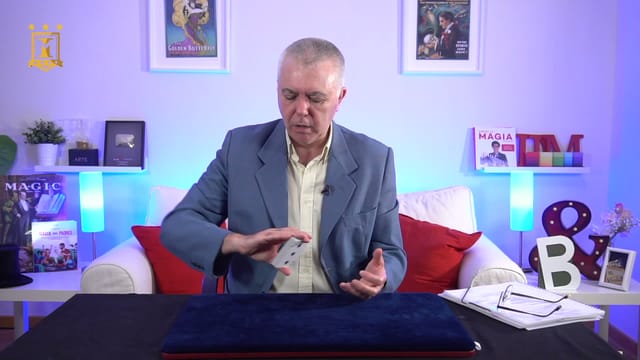
One-Hand Palm and Chosen Card Travel
A supposed demonstration of skill ends in an impossible journey. Miguel Gómez uses this routine to study the one-hand palm, the addition of a card, and two false counts, linking the mechanics to audience attention and the clarity of the effect.
From Apparent Skill to Magical Travel
A card is selected and lost in the deck. The magician tries to find it using a cut with a margin of five cards: the first group does not contain the selection and the second one does. To correct the apparent failure, he proposes to make the card travel to the first group.
Following the magical gesture, the packet containing the selection has four cards and the other has six, including the chosen card. The class shows the performance, explains the method, and reviews the complete routine. The presentation gives a reason for the cuts, the two groups, and the checks prior to the travel.
Position, Sensitivity, and Practice
The starting point is feeling comfortable holding a card in classic palm. The rest position between the pinky tip and the base of the thumb is reviewed, and practicing with both hands is proposed, without confusing firmness with tension.
Gómez dedicates a block to training. He explains his experience of alternating practice and rest when a block appears and advises working in moderation. The goal is to acquire coordination and sensitivity: understanding the move is not enough to execute it steadily.
One-Hand Palm
The explanation develops the placement of the thumb and the other fingers on the deck. The pinky initiates a slight shift of the top card and then changes the direction of the pressure to take it into the palm.
Common errors are analyzed: squeezing so hard that the card does not move, shifting it excessively, or placing the thumb so that the card ends up outside the desired position. The pressure must allow control of the deck and moving a single card with precision.
The cover work combines three elements: a refined technique, the activity of the other hand, and a translation movement that integrates the maneuver. Palming with the isolated, still hand is compared to doing it while the main action leads attention elsewhere.
Control, Steal, and Addition
The routine uses a selection and return consistent with the overhand shuffle. Grip, in-jog that preserves a reference, and card counting accompanied by words and gestures are studied. A sliding cut and the extraction of the two groups link this control with the presentation of skill.
The Biddle count allows showing the selection inside the second group and retaining it for the transfer. It explains when to ask the participant, when to separate the hands, and how to coordinate the palm with the action of setting the deck aside.
The addition is made onto a slightly un-squared packet. The explanation insists on opening the hand upon completing the action and keeping the movement relaxed. The position of the cards helps integrate the new card into the whole.
Two False Counts with Different Functions
The first count apparently shows five cards on the table and hides the chosen one that has been added. It uses a variant of the glide and a double handling. It is studied how to maintain the rhythm and cover the edge of the cards so that the sequence maintains a uniform appearance.
The second one is Gómez's natural false count, which presents four cards as five. It starts from rehearsing an authentic count and modifies the placement and displacement of the cards to preserve their look. The instructor explains the detail of rhythm and movement that his variant provides.
Both counts prepare the situation that the audience must remember before the travel. They do not only fulfill a technical function: they confirm the apparent number of cards and where the selection is located.
Magical Moment and Handling Alternative
The explanation brings the confirmation of the initial situation close to the magical moment. Once the conditions are established, the gesture represents the travel and the revelation allows comparing the two packets. The position of the hands and the way of showing the result are also reviewed.
As an alternative, Gómez shows where to incorporate a two-hand palm, taking advantage of a question to the spectator. This option preserves the construction of the routine and allows working on it with a known palm while practicing the one-hand one.
Material and Requirements
You need a standard deck, a table, and a participant. It is convenient to be familiar with the classic palm, breaks, and the overhand shuffle. The class explains the one-hand palm, the counts, and their application; the alternative presupposes knowing a two-hand palm.
Practice the entry into the palm, the addition, and each count separately. Then rehearse the complete sequence with its questions and pauses: the control and the order of the packets must work without depending on knowing the identity of the selection beforehand.