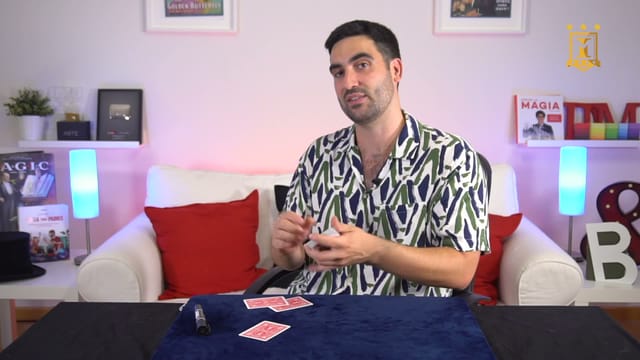
Card Changes: Top Change, Kaps and Variations
A card change takes more than just swapping two objects without getting caught. Hugo Maximiliano analyzes the mechanics, the intent behind the gesture, and the exact moment of attention required to pull it off. This masterclass compares several tools and applies them directly to a full routine of Everywhere and Nowhere.
The Top Change as a Secret Move
There's a big difference between a false action—like a sham shuffle that looks completely legit—and a sleight that the spectator shouldn't even register as an independent move. Grasping that distinction is key to mastering the Top Change and picking the right moment to drop it.
The tutorial covers the grip, the contact between the cards, hand coordination, and a silky-smooth change. He zeroes in on the role of the dealing hand, keeping the other hand steady, and avoiding any extra finger twitching. The goal here is to dial down the tension and match the natural rhythm of your movements instead of telegraphing the switch.
Cover is broken down into tension and relaxation cycles. We look at post-reveal moments, asking questions, pointing, and shifts in audience attention that let you seamlessly weave the Top Change into your magic. Your body and arms can also provide physical cover, especially when you're working standing up. The timing has to grow naturally out of the routine, rather than feeling like an isolated, gratuitous move.
Kaps Change and Spread Change
The Kaps Change is taught using a face-up selection and a casual gesture of setting the card down. The breakdown ties together movement, pacing, and a relaxed attitude with the visual info the spectator takes in. He explains how to give the card some presence during its journey without turning every single move into a heavy, dramatic demonstration.
Another switch relies on spreading and turning the card over. We study packet positioning, hand-to-hand coordination, and keeping the flow smooth when dropping the card onto the table. The instructor compares this handling with another method used during the turnover and explains why he prefers a more open gestural style in certain situations.
Transformation examples help you see what each tool can really do. The teaching focuses on the changes and the conditions for using them, wrapping up with the full routine explained at the end.
Hofzinser and LePaul Variations
The Hofzinser variation gives the change a logical, visible action, like snapping your fingers or squaring up a card. It covers getting the break ready, the grip, and justifying the gesture based on your patter.
LePaul's variation tweaks the grip and the direction of the move. He explains its connection to a second deal from that position, while keeping the dealing hand fully functional. Different angles of intent and appearance are compared, reminding us not to treat every change as a one-size-fits-all swap for any moment.
Everywhere and Nowhere
The routine kicks off with some failed attempts to track down a selection using various magical gestures. A magic wand seems to save the day: several cards transform into the chosen one, and that same identity seems to multiply all through the deck. In the end, that illusion vanishes, and the selection pops up in your pocket.
Step-by-step, the explanation covers duplicating cards, using a short-corner card, the selection and return, and the sequence of displayed cards. We put the double lift, various changes, and Top Change cover to work after every surprise.
The Hindu shuffle display is also worked on to create the illusion of a deck full of identical cards. He breaks down the rhythm, the finish, and the transition into getting everything clean. The finale ties together the palm, turning the cards over, and the pocket production so you can hand out the deck free of extra duplicates.
Materials and Setup
You'll need a standard deck, two duplicates of one of its cards—making three of that identity in total—and a short-corner card. The Queen of Hearts and Six of Hearts used in the video are the instructor's choices, not strict requirements.
The presentation uses a marker as a wand, a table to set cards down on, and an accessible pocket. A salt shaker is mentioned as an alternative prop, but you don't need it to put this version together.
You should already be comfortable with breaks, double lifts, card controls, Hindu shuffling, and palming multiple cards. This routine puts those tools into action and details how they link together, but it doesn't replace learning each auxiliary sleight from scratch. Practice the changes and their covers first, and then tackle the whole sequence with all its questions, gestures, and reveals.