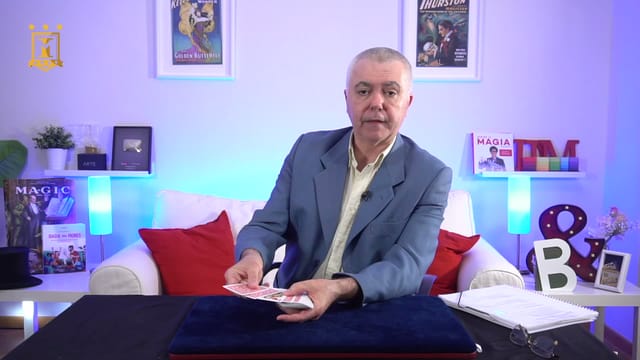
Top Palm while cutting and Never Six with a chosen card
The classic palm in the hand holding the deck allows you to link secret moves with ordinary-looking cuts. Miguel Gómez develops this possibility through his semi-technical handling and a complete version of Never Six, from performance to explanation and a review of its tricky moments.
The effect and its construction
The spectator shuffles, chooses a card, and loses it in the deck. Then they hand over six cards to identify their selection by its characteristics. When counting them, a seventh appears: one is removed, but there are seven again. The situation repeats even when the participant counts the cards. Finally, the apparent packet reduces to a single card, which turns out to be the chosen one.
The presentation links this climax with the initial purpose of locating a card. We study the change in attitude toward repetitions, the spectator's collaboration, and the pauses that allow each appearance to be appreciated. The final analysis addresses how to interpret the apparent rebelliousness of the cards without overacting and how to give a clear conclusion to the sequence.
Palming in the deck hand
The work focuses on the left hand for those who usually hold the deck in it; the criteria adapt to those who use the right. It explains how the deck itself offers cover and allows the other hand to remain free to express itself.
The elevated grip leaves space for the palmed cards. We study their placement, the tilt of the hand, and the transition between that grip and the usual position. The practice seeks comfort and a stable appearance, both with and without hidden cards.
Gómez also suggests training expression with both hands: pointing, asking, or accompanying the patter without making either of them look immobilized. That naturalness is part of the learning process along with the position of the cards.
Palming and replacing while cutting
The technique integrates palming a small group during a cut. The elevated grip makes it easier for the cards to reach the palm position through the movement of the packets themselves. The teacher distinguishes the hidden action from its outer appearance and explains why he calls this handling semi-technical.
Replacing the cards allows you to return the group onto another packet with the appearance of a new cut. We develop finger placement and the coordination needed to gather the cards in a single action. The economy of movement avoids unloading first and then adding an independent adjustment.
Setting up the routine during handling
The explanation teaches how to control the selection to third position from the top by returning it between packets and cuts. We analyze how to prepare the references while the participant shows the card and how to keep the opening natural to receive it.
An explanatory action regarding the characteristics of the cards establishes the layout needed for Never Six. We detail pushing off two cards with different areas of the thumb pad, handling several as one, and the turnovers preceding the palm. This prepares the sequence during the presentation, starting from a shuffled deck by the spectator.
The subsequent choice of six cards and the collection of the deck provide the context for replacing the cards. We review the priority of hand movement, the exact moment of receiving the first card, and the cover provided by the participant's activity.
Counts, participation, and climax
The entire succession of counts and removals is explained. The instructions given to the spectator have a specific function: they allow them to count and verify the results without altering the necessary arrangement. The performance makes it clear that the chosen one does not appear among the shown cards.
The final phases incorporate Biddle counts, with breaks and card steals that prepare the vanishing of the packet. The review also details how to match the gesture and sound when placing cards on the table.
Before the revelation, we study the hand's position relative to the audience and the participant. The patter about the characteristics of the choice creates a pause between the technical action and the magical moment. The finale must clearly show that a single card remains and then confirm its identity.
Materials and practice
You need an ordinary deck, a table, and a participant for the routine. It helps to know the classic palm position and handle breaks, spreads, and cuts smoothly. The class develops the palm while cutting, its return, and the necessary counts, but linking them requires practice.
Work first on the elevated grip and the two cutting moves; then, the order of the counts and the instructions to the spectator. The complete review lets you check the positions before adding the performance and adjusting the angles.