False Shuffles: Erdnase, Diaconis, Push-Through, and Zarrow
A false shuffle can preserve just a portion of the deck or keep its entire stack. Manolo Talman explains both situations and compares in-the-hands handlings, table riffle shuffles, and an apparent ribbon spread shuffle. The work focuses on execution, rhythm, and the relationship between the look of the shuffle and the patter.
In-the-Hands Shuffles
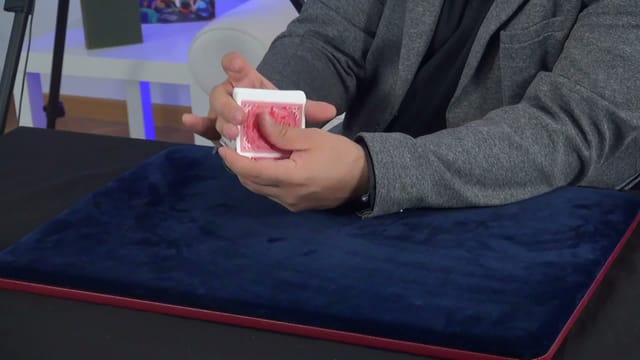
The Erdnase partial shuffle is the starting point. Hand positions, the handling of a reference, and two ways to finish the sequence are studied. This procedure preserves the top stock; the four aces serve as an example to follow that block, but the application is not limited to those four cards.
The explanation includes how to avoid stealing extra cards when the break is reached and why it is a good idea to master passing cards one by one. Practice by touch and peripheral vision is worked on to maintain eye contact with the audience instead of constantly staring at your hands.
The Diaconis shuffle expands the work to the preservation of the full stack. The packet sequence, in-jogged and out-jogged cards, and the coordination of a double break are developed. There are slow repetitions to study the positions and distinguish the moments of the handling, in addition to its linked execution.
Push-Through and Stevens Variant
The table block begins with the closed riffle shuffle. The push-through is explained with attention to hand placement, the interlacing of the cards, and the extraction of the packets. It studies how to facilitate that extraction without squeezing the cards and how to coordinate it with the movement of the hands.
Patter and body language are also part of the sequence: the interest generated by the shuffle is contrasted with the relaxation upon finishing it. The masterclass then develops a variant attributed to Stevens, featuring an apparent cut before completing the extraction. The two constructions and the continuity of their actions are compared, keeping the order of the entire deck as the goal.
Zarrow and Talman's Adaptation
The explanation of the Zarrow compares what the person shuffling sees with the audience's perspective. The initial slip cut, the arrangement of the packets, the covers, and the movement of both hands are reviewed. It analyzes why certain extra gestures when squaring or lifting a card might look different from those of a genuine shuffle.
Details of height, position, and relaxation are repeated so you can study the sequence clearly. Talman differentiates the handling he presents as traditional from his personal adaptation, called the Zarrow-Talman. The latter links two shuffles and a cut-based termination to recover the full stack. The demonstrations show both the sequence and the differences between its phases.
Apparent Ribbon Spread Shuffle
The final handling presents the cards spread on the table with the appearance of a thoroughly mixed deck. The layout and gathering of the ribbons are explained, repeated slowly, and shown with the faces visible to follow the stack preservation.
Possible uses are discussed before an Oil and Water routine, alternating color effects, or a gambling demonstration. These are examples of how to apply the shuffle; those routines are not explained as complete effects within this recording.
Material and Practice
Use a standard deck and a table with enough room to separate packets and spread the cards. The table work is presented on a close-up pad. The aces allow you to check the partial shuffle, and a previously stacked deck helps review the total shuffles: the handlings preserve a prepared stack, they do not sort a genuinely shuffled deck.
It is helpful to be fluent with in-the-hands shuffles, passing cards one by one, and the table riffle shuffle. The necessary positions and breaks are explained, but the extraction and coordination of both hands require specific practice. A false cut can complete some sequences; a complete cut tutorial is not presented within this class.
Compare your false shuffle to a real shuffle and practice without tension in your fingers. Review the look from the front, the continuity when squaring, and eye shifts, maintaining a rhythm that allows you to keep conversing.